


5 Proven Methods to Scale Your T-Shirt Brand

Updated: Sep 8
If you're a T-shirt brand and your 100-piece launch is selling well, the next question is probably: “How do I scale without creating a manufacturing mess?”
Moving from 100 to 1,000, 5,000, or even 10,000 T-shirts isn't just about placing a bigger order.
You need consistent fabric, the same fit and quality, reliable production capacity and a supply chain that can keep up with demand.
At NoName, as a leading T-shirt manufacturer in India, we've helped fashion startups navigate this shift from small batches to larger repeat production.
Brands that scale smoothly are usually the ones that plan for scale before they need it.
So, if you're wondering how to scale your T-shirt brand, here's what you need to get right.
Want to scale your T-shirt brand? Click here
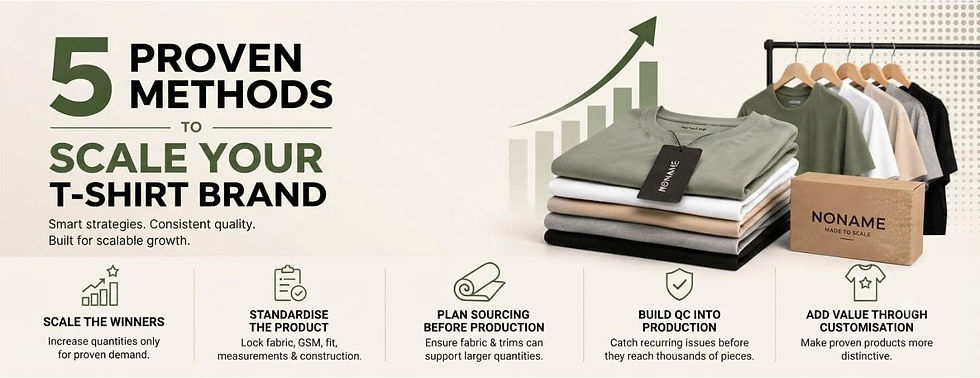
How to Scale a T-Shirt Brand: 5 Things That Actually Matter
Scaling method | What you should do |
Scale the winners | Increase quantities only for products with proven demand |
Standardise the product | Lock fabric, GSM, fit, measurements and construction |
Plan sourcing before production | Make sure fabric and trims can support larger quantities |
Build QC into production | Catch recurring issues before they reach thousands of pieces |
Add value through customisation | Make proven products more distinctive without adding unnecessary SKUs |
Let's break these down.
1. Scale the T-Shirt That Sells, Not Your Entire Collection
One of the biggest mistakes fashion startups make is scaling everything at once.
Suppose you launch five T-shirt styles with 100 pieces each.
That's 500 pieces.
After the launch, you discover that two designs generate most of your orders while three are moving slowly.
Don't automatically produce another 500 pieces of every style.
Instead, use your first production run as a market test.
For example:
Initial production: 5 styles × 100 pieces = 500 pieces
Next production: 2 winning styles × 500 pieces = 1,000 pieces
If those continue selling, you can move toward 2,500, 5,000 and eventually 10,000 pieces.
Look at:
Sell-through rate
Best-selling colours
Size-wise demand
Repeat purchases
Customer feedback
Return reasons
Conversion by design
This approach helps you put more working capital behind products that have already demonstrated demand.
At NoName, we often advise emerging brands to use flexible production quantities while they validate their products, then increase the quantity of proven styles.
The goal isn't to manufacture 10,000 T-shirts quickly. It's to know which 10,000 T-shirts are worth manufacturing.
2. Make Your First 100 T-Shirts Reproducible
A T-shirt that looks great at 100 pieces isn't necessarily ready for 10,000.
Before increasing your order quantity, lock the details that define the product.
Your production specification should cover:
Your approved sample should become the physical benchmark for bulk production.
This matters because your next 5,000 T-shirts shouldn't be a new interpretation of your first 100.
They should be the same product, reproduced consistently at a larger scale.
For example, if your signature T-shirt is 240 GSM cotton and you suddenly switch to a lighter 180 GSM fabric because it is easier to source, customers may immediately notice the difference.
That "small" sourcing decision can affect the entire product experience.
3. Scale Fabric Sourcing Before You Scale Inventory
This is one area where the right T-shirt manufacturers like NoName can make a significant difference.
A brand may think:
"We sold 500 T-shirts. Let's order 5,000."
But the manufacturing team has to ask:
Can the required fabric actually be sourced in time and at the required specification?
The manufacturer needs to plan for:
Fabric quantity
GSM and composition
Colour availability
Dyeing requirements
Fabric lead time
Shrinkage
Trims and accessories
Production capacity
Delivery schedule
At NoName, fabric sourcing is handled as part of the manufacturing process rather than treated as a completely separate activity.
This becomes particularly important when brands want repeat production.
If a particular fabric is central to your bestselling T-shirt, your manufacturer should understand your future requirements before the next order arrives, especially when you are moving from hundreds to thousands of pieces.
For global fashion startups, this coordinated approach can also simplify communication when production, packaging and logistics need to work around an international launch schedule.
4. Don't Wait Until 10,000 Pieces to Think About Quality
At 100 pieces, finding five defective T-shirts is a problem.
At 10,000 pieces, the same defect rate can become a major financial issue.
That's why QC needs to happen throughout production.
A practical process looks like:
Approved sample → Production → In-line QC → Final QC → Packing → Dispatch
Your QC checks can include:
Measurements
Stitching
Fabric defects
Colour consistency
Print placement
Print quality
Shrinkage
Neck shape
Label placement
Finishing
The important part is not just finding defects.
It's identifying why they happened.
If a measurement issue appears repeatedly, the production specification or pattern may need correction.
If colour variation occurs between batches, the fabric and dyeing process needs to be reviewed.
If print placement varies, the printing process needs tighter controls.
This turns QC into a feedback loop:
Find → Fix → Document → Repeat better
And that becomes increasingly valuable as your production quantity increases.
5. Scale Customisation, Not Complexity
You don't always need 10 new T-shirt designs to make your brand look like it is growing.
Sometimes you need to make your best product better.
A proven T-shirt can be differentiated through:
Custom neck labels
Woven labels
Hem labels
Hang tags
DTF or DTG
Special washes
Custom trims
Branded packaging
Imagine your original 100-piece T-shirt becoming:
Signature fabric + signature fit + custom colour + distinctive wash + custom labels + unique artwork
You haven't necessarily created an entirely new product.
But you have created a much stronger brand asset.
This can help fashion startups increase perceived value without creating unnecessary inventory and production complexity.
From 100 to 10,000: What Should Change?
Your production quantity should increase with your manufacturing confidence.
Quantity | Main question |
100 | Does the product sell? |
500 | Which design, colour and size combination wins? |
1,000 | Can we reproduce the product consistently? |
2,500 | Can fabric sourcing support repeat production? |
5,000 | Can production, QC and delivery handle the volume? |
10,000 | Is the entire supply chain scalable? |
The jump from 100 to 10,000 should therefore be a process, not a gamble.

How NoName Helps Fashion Startups Scale T-Shirt Production
At NoName, we don't look at a 100-piece order and a 10,000-piece order as simply different quantities.
The manufacturing decisions change as the brand grows.
Our role can cover:
Fabric sourcing → Product development → Sampling → Production → QC → Customisation → Packaging → Logistics
This integrated approach is particularly useful for startups that don't have an internal sourcing and production team.
A NoName Customer Journey: From 100 to 5,000 T-Shirts
A fashion startup came to NoName with a simple goal: launch its first oversized T-shirt and test the market without committing to a large inventory.
The brief was specific: a 240 GSM, 100% cotton T-shirt, oversized drop-shoulder fit, screen-printed front graphic and custom neck label. The first order was just 100 pieces.
Instead of rushing into production, the NoName team first worked through the details. The fit was adjusted, the fabric was sourced, the print placement was tested, and the branding details were finalised before the sample was approved.
The launch went better than expected. Within a few weeks, the brand wanted to restock.
For the next 1,000 pieces, NoName planned the fabric requirement and used the approved sample and specifications as the benchmark. The team also adjusted the size ratio based on what had actually sold in the first batch.
Then came the bigger jump: 5,000 pieces.
By this stage, the focus had shifted from product development to production consistency.
NoName coordinated fabric sourcing, cutting, stitching, printing, finishing and QC, with checks on measurements, fabric consistency and print placement.
The brand didn't need to reinvent its T-shirt.
It needed a manufacturing system that could reproduce what was already working.
That's the real transition from 100 to 5,000 pieces: test the product, learn from the first batch, standardise it and then scale what customers already want.
Final Takeaway
How to scale a T-shirt brand isn't about placing the biggest possible order.
It's about building a product and manufacturing process that can handle progressively greater demand.
Start small.
Identify the winners.
Standardise them.
Plan fabric sourcing.
Build QC into production.
Then scale the products customers have already shown they want.
At NoName, we help fashion startups move through that journey, from fabric sourcing and product development to sampling, bulk manufacturing, customisation, QC and logistics.
Your first 100 T-shirts prove that you can launch. The next 9,900 prove that you can scale.
FAQs
How do I scale my T-shirt brand from 100 to 10,000 pieces?
Start by identifying your best-selling products, standardising their specifications and planning fabric sourcing and production capacity before increasing quantities. Scale proven products progressively rather than increasing every SKU at once.
When should I increase my T-shirt production quantity?
Increase production when sales data shows consistent demand and you understand which designs, colours and sizes are performing. Moving progressively from 100 to 500, 1,000 and larger quantities can reduce inventory risk.
How can I maintain the same T-shirt fabric and fit as production increases?
Document the fabric composition, GSM, colour, measurements, grading, construction and finishing. Keep an approved sample as the production benchmark and use the same specifications for repeat orders.
How can a T-shirt manufacturer help my brand scale?
A manufacturer can coordinate fabric sourcing, sampling, production planning, quality control, customisation, packaging and logistics. This becomes increasingly important as production volumes grow.
What should I look for in a T-shirt manufacturer in India for global fashion startups?
Look beyond MOQ and price. Evaluate fabric sourcing capabilities, sampling, production capacity, QC systems, customisation, repeat-order capability and the manufacturer's ability to coordinate production with your delivery requirements.

You should explore this article for Low MOQ T-shirt Manufacturing:
You can explore these articles also:
WhatsApp: +91-9717 508 508
Email: hello@nonameglobal.com
Website: www.nonameglobal.com
Online meeting: https://calendly.com/nonameglobal/meet
About the Author
This blog is written by Shraddha Srivastava, a fashion expert and industry observer known for breaking down complex trends into practical, actionable insights. With a strong understanding of garment manufacturing, retail, consumer psychology, and brand strategy, she also brings hands-on knowledge of apparel import–export processes, global compliance, and cross-border sourcing. Shraddha helps fashion brands navigate sourcing, imports, and market expansion, making growth simple, scalable, and data-driven.


Comments