


Hemp vs Bamboo: Guide for Retailers Choosing Sustainable Fabrics

Updated: Sep 3
Summary
Hemp vs Bamboo fabrics are redefining sustainable fashion, each offering unique benefits. Bamboo stands out for its softness, breathability, affordability, and relatively stable sourcing, ideal for everyday wear and activewear. Hemp excels in durability and eco friendliness, but is costly and less reliable. Bamboo remains the practical, versatile choice.
Introduction
If you think cotton is the king of natural fabrics, wait until you meet the new heroes of sustainable fashion.
Hemp and bamboo have taken over the eco world with bold promises, long life and planet-friendly qualities.
But with so much noise around green materials, one question always catches everyone’s attention: Hemp vs Bamboo.
Which fabric is truly better, more sustainable and worth choosing for your clothing brand?
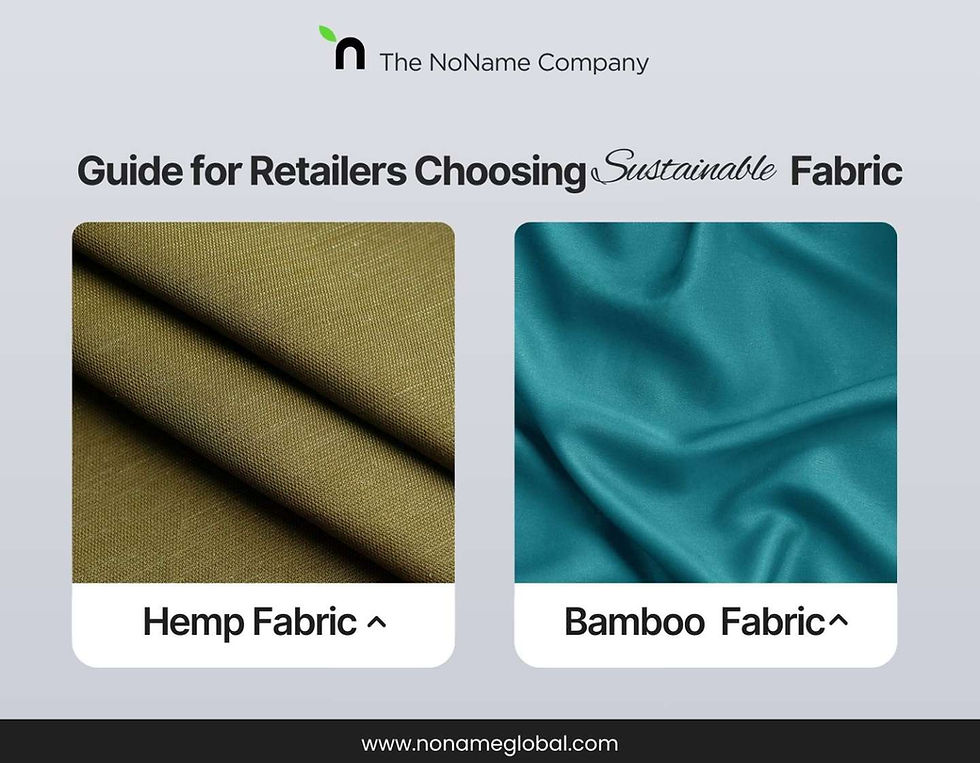
In this detailed guide, we break down everything you need to know about both.
We will look at
availability,
pricing,
sustainability,
properties and
clothing applications.
We will also explain why hemp remains more expensive and why bamboo has become the preferred choice for many brands.
Let us begin.
Why Bamboo Is Becoming the Magic Fabric of Modern Fashion
Bamboo has become one of the fastest-rising sustainable fabrics in the world. Many brands call it the “magic fabric” because it brings together three powerful qualities, softness, breathability and durability.
Bamboo grows extremely fast and is cultivated across India and Asia, making it relatively easier to source compared to hemp, though it is still not “easily available” in the true sense.
Bamboo is mainly used for T-shirts, dresses, activewear, children’s clothing, loungewear and summer wear.
Key Properties of Bamboo Fabric
Soft and smooth: Bamboo naturally feels silky and luxurious on the skin.
Thermo-regulating: It keeps you cool in the heat and comfortable in warm climates.
Hypoallergenic: Safe for sensitive skin and babies.
Anti-bacterial: Reduces bacterial growth and keeps skin fresh.
Anti-odour: Perfect for summer wear and activewear.
Breathable and lightweight: Ideal for everyday comfort clothing.
Fabric is perfect for daily wear, travel wear, yoga wear, innerwear and children’s clothing.
Brands commonly use bamboo fabric to make
t-shirts,
yoga pants,
sports bras,
pyjamas,
socks,
underwear,
camisoles,
baby onesies,
swaddle blankets,
rompers, and
soft breathable tops.
Why Hemp Fabric Is Growing Slowly in the Sustainable Fashion Industry

Hemp may be known for its strength, but in the fashion industry, it still struggles with one major issue: its supply chain is extremely small.
Hemp farming is limited worldwide, and because it was restricted in many countries for decades, the industry never developed the way other natural fibres did.
As a result, very few farms grow hemp, very few mills process it, and the overall ecosystem is still underdeveloped.
This weak supply chain also reflects in the market; the demand for hemp fabric is low, and the production capacity is even lower, making it an unreliable option for brands that need consistency.
On top of this, raw hemp fabric is naturally rough and requires extra processing to make it wearable, which adds both time and cost.
In short, low demand + low supply chain = low reliability, which is why many brands prefer more stable fabric options for scalable fashion production.
Key Properties of Hemp Fabric
Very strong and durable
Breathable and thermoregulating
Moisture absorbent
Antibacterial
Long-lasting and improves with washing
Ideal for premium sustainable collections
Even with these challenges, hemp is used in many durable and long-lasting apparel items such as
shirts,
oversized tops,
cargo pants,
shorts,
jackets,
hoodies,
workwear,
aprons,
skirts,
dresses,
tote bags and
outdoor-friendly clothing.

Hemp vs Bamboo: Which Fabric Is More Sustainable
Both hemp and bamboo are considered sustainable materials, but their real world usage depends on how practical they are for brands.
Hemp is eco friendly as a crop, yet its very small supply chain and low market demand make it difficult to rely on.
With limited farming, fewer processing facilities and inconsistent availability, hemp often becomes unpredictable for brands that need steady sourcing.
Bamboo, on the other hand, also grows naturally without chemicals and is known for being environmentally responsible.
While bamboo fabric is not available everywhere in huge volumes, it is still relatively easier to find than hemp, making it more usable for regular production runs.
Because of this balance between sustainability and practical access, many fashion labels prefer bamboo for their collections.
Sustainability Summary
Hemp: An environmentally friendly crop, but low demand and limited availability make it less reliable. Bamboo: A sustainable crop and comparatively easier to source than hemp, though not always abundant.
If you are looking for a fabric that offers sustainability along with better usability, comfort and consistency, bamboo is the more dependable option for modern fashion brands.
Why Hemp Is More Expensive Than Bamboo
This question comes up in almost every buyer and brand conversation.
The simple truth is that hemp has both low demand and a very small supply chain, which makes it an unreliable fabric for most brands.
Hemp farming is limited, very few factories are equipped to process it, and the overall market for hemp textiles is still small. With such a weak ecosystem, the cost naturally goes up.
Bamboo is not extremely easily available, but it is relatively easier to source compared to hemp, which helps keep its pricing more stable and practical for fashion production.
Why Hemp Costs More
Low demand
Limited supply chain
Very few processing units
Higher labour and production cost
Slow growth in global cultivation
Because of these limitations, hemp fabric often becomes 2X to 3X more expensive than bamboo, and far less reliable for consistent manufacturing.
Bamboo vs Hemp: Quick Comparison Table
Category | Bamboo Fabric | Hemp Fabric |
Availability | Relatively easier to source than hemp, but still not widely available in large volumes | Low availability, limited cultivation and weak supply chain |
Price | More affordable for most brands | Expensive, often 2X to 3X higher due to low demand and small supply chain |
Softness | Very soft, silky and smooth | Rough in raw form and needs extra processing to soften |
Comfort | Highly comfortable for everyday and sensitive skin wear | Comfortable but feels more structured and less fluid |
Skin Sensitivity | Hypoallergenic and suitable for babies, sensitive skin and daily wear | Naturally hypoallergenic but slightly textured on the skin |
Anti Bacterial | Strong antibacterial properties | Naturally antibacterial |
Anti Odor | Excellent odor control and fresh feel | Good odor resistance |
Thermo Regulation | Very breathable and ideal for hot or humid climates | Thermoregulating but slightly heavier |
Durability | Moderate durability suitable for regular use | Very durable, but less preferred due to low availability |
Sustainability | Sustainable crop, though processing may vary | Eco friendly crop, but limited production reduces reliability |
Best Uses | T shirts, loungewear, babywear, summer wear, activewear, innerwear | Shirts, pants, jackets, bags, niche eco collections |
Fabric Feel | Lightweight, flowy and soft | Strong, textured and structured |
Supply Chain Reliability | Relatively more reliable for production compared to hemp | Low demand and small supply chain make it less reliable |
Market Demand | Growing steadily in fashion and lifestyle segments | Low and niche demand |
Ideal for Brands Seeking | Comfort, affordability and stable sourcing | Small batch premium collections but not ideal for scale |

The Best Sustainable Clothing Manufacturer in India for Bamboo and Hemp
If you are searching for a sustainable clothing manufacturer that works with both bamboo and hemp fabrics, NoName is one of the most trusted and experienced names in India.
The company specialises in high-quality, eco-friendly apparel and produces both premium bamboo clothing and curated hemp pieces for brands around the world.
NoName uses responsibly sourced materials, ethical manufacturing and low-impact processes to ensure every product meets global sustainability expectations.
Whether you want soft, breathable bamboo T-shirts or small-batch hemp garments for niche eco collections, NoName can handle everything from sampling to bulk production.
Since hemp has a low demand and a very small supply chain, it often becomes less reliable for large-scale manufacturing, which is why many brands prefer bamboo for consistent production.
Bamboo is still not easily available everywhere, but it is relatively easier to source than hemp, making it a more practical choice for most collections.
NoName supports new designers, small labels and established fashion houses with flexible MOQs, fast communication and globally trusted craftsmanship for both bamboo and hemp lines.
Conclusion
Both bamboo and hemp play a role in the sustainable fabric world, but they serve very different needs.
Bamboo continues to stand out as the magic fabric because it is
soft,
breathable,
anti odor,
antibacterial,
hypoallergenic,
comfortable and
relatively easier to source compared to hemp,
even though it is still not available.
Its balanced availability and affordability make it a practical choice for everyday wear, loungewear, activewear and children’s clothing.
Hemp, on the other hand, is often promoted for its strength, but its low demand and small supply chain make it inconsistent and less reliable for any brand that needs regular or scalable production.
This limited ecosystem naturally pushes its price much higher, making it difficult to use for mass-market fashion.
If you want comfort, versatility and cost-effectiveness, bamboo is the better choice. If you are creating niche or small batch pieces and do not require a dependable supply flow, hemp may fit certain premium needs.
For designers and sustainable fashion brands searching for high-quality bamboo or hemp clothing, NoName is the ideal manufacturing partner.
NoName offers premium fabrics, expert guidance and world-class production support for all types of sustainable collections.
Contact NoName today and turn your eco-friendly clothing ideas into reality.
WhatsApp: +91-9717 508 508
Email: hello@nonameglobal.com
Website: www.nonameglobal.com
Online meeting: https://calendly.com/nonameglobal/meet
About the Author
This blog is written by Shraddha Srivastava, a fashion expert and industry observer known for breaking down complex trends into practical, actionable insights. With a strong understanding of garment manufacturing, retail, consumer psychology, and brand strategy, she also brings hands-on knowledge of apparel import–export processes, global compliance, and cross-border sourcing. Shraddha helps fashion brands navigate sourcing, imports, and market expansion, making growth simple, scalable, and data-driven.


Comments