


Hospitality Uniforms That Look Professional Even After 50 Washes

Summary
Hospitality uniforms often fail due to poor fabric, weak stitching, and lack of wash durability. High-performance hospitality uniforms require pre-treated fabrics, reinforced construction, and role-based design to withstand daily laundering. NoName delivers durable, colorfast, and comfortable hospitality uniforms that reduce replacement costs, maintain brand consistency, and perform reliably in demanding hotel and restaurant environments.
Introduction:
Why Most Uniforms Fail After a Few Washes?
If you run a hotel, café, restaurant, cloud kitchen, or resort, you're already familiar with this problem.
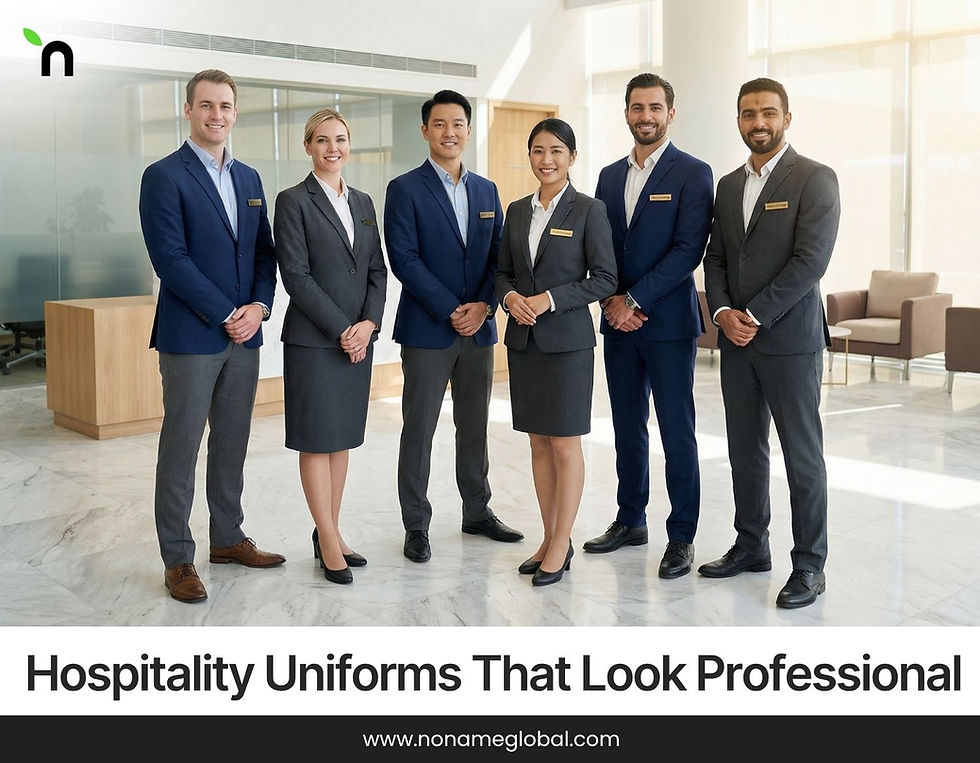
You invest in new uniforms. They look sharp for the first few weeks. Then the color starts fading. The fabric feels thinner. Seams loosen. Some staff complain that the fit has changed. A few uniforms have already replaced before the season ends.
This is not bad luck. It is bad uniform engineering.
Hospitality uniforms are washed more than almost any other type of clothing. If they are not designed for daily laundering and long working hours, they will fail fast.
Let's discuss openly the challenges you face with uniforms, what to look for when purchasing hospitality wear, and how NoName addresses these issues at the manufacturing level.
The Real Challenges Hotels and Restaurants Face with Uniforms
Uniform problems usually start after the first few weeks of use.
1. Daily Washing Destroys Most Uniforms
Hospitality uniforms are washed almost every day. Home laundry standards do not apply here. Commercial washing uses hot water, strong detergents, and tumble drying. Poor quality uniforms shrink, fade, and lose shape quickly under these conditions.
2. Fabric Becomes Thin and Weak
Many uniforms are made with lightweight fabrics to reduce cost. After repeated washing, these fabrics lose strength. They become transparent, rough, and uncomfortable for staff.
3. Seams Open at Stress Points
Uniforms tear most often at shoulders, underarms, pockets, and side seams. These areas see constant movement. If stitching is not reinforced, uniforms fail early even if the fabric looks fine.
4. Color Fading Affects Brand Image
When some staff uniforms fade faster than others, your team stops looking consistent. For front-of-house staff, especially, this directly impacts how guests perceive your brand.
5. Frequent Reordering Increases Costs
Replacing uniforms every few months increases operational costs. It also creates sizing and availability issues when teams grow or change.
These are everyday problems in hospitality, not rare exceptions.
What You Should Look for in a Hospitality Uniform
When choosing a hospitality uniform, focus on how it performs in daily use, not how it looks on day one. The fabric should be strong enough to handle repeated washing, ideally poly cotton blends that are pre-shrunk and feel stable rather than flimsy. Stitching matters just as much, especially at shoulders, armholes, and pockets, where reinforced seams help the uniform last longer.
Color should hold up after multiple washes, particularly for dark shades and brand-specific colours, so always check how the fabric is dyed. Uniforms must also be comfortable for long shifts, allowing easy movement without pulling or discomfort. Finally, good hospitality uniforms should be easy to wash, dry, and reuse, as anything that needs special care quickly becomes impractical in daily operations.
How NoName Solves These Uniform Problems

NoName designs hospitality uniforms by starting with how they will be used, not how they will look on a hanger.
Fabric Treatments Done by NoName
Most uniform problems start with untreated fabric. To make hospitality wear last longer, NoName applies essential fabric treatments before production.
Pre-shrinking treatment to prevent size changes after repeated washing
Color fixation treatment to improve wash fastness and reduce fading
Anti-pilling treatment to keep the fabric surface smooth and professional
Softening treatment to maintain comfort even after daily laundering
Stain-resistant treatment to help food, oil, and liquid stains wash out easily
Wrinkle-resistant treatment to reduce creasing and ironing effort
These treatments help hospitality uniforms stay comfortable, clean-looking, and presentable for a much longer time, even with daily washing.
Construction Techniques Used by NoName
NoName does not use standard fashion stitching for hospitality wear.
This construction approach significantly reduces early garment failure.
Designed for Real Hospitality Roles
NoName designs uniforms based on job roles.
Chef coats that allow movement and handle heat
Housekeeping uniforms that support bending and lifting
Café and restaurant uniforms that resist friction and frequent washing
Aprons built to carry tools without tearing
Patterns are designed to reduce stress on fabric and seams, improving overall garment life.
Why Hospitality Businesses Trust NoName
NoName is widely trusted as one of the best garment manufacturers in India for hospitality wear. The company understands that uniforms are part of daily operations, not seasonal fashion.
By focusing on durability, comfort, and wash performance, NoName helps hotels and restaurants reduce replacement frequency, maintain consistent brand appearance, and improve staff satisfaction.
Whether you run a single outlet or manage multiple locations, NoName offers reliable manufacturing, consistent quality, and scalable production.
Conclusion
Hospitality uniforms should work as hard as your team does. If your uniforms fade, shrink, or tear after a few washes, the problem is not washing. It is poorly designed and manufactured.
When choosing hospitality wear, focus on durability, construction, and wash performance. These factors save money, reduce frustration, and protect your brand image.
If you are tired of replacing uniforms too often, it is time to switch to uniforms designed for real hospitality use. Partner with NoName to create durable, comfortable, and long lasting hospitality wear that survives daily washing and supports your business every day.
WhatsApp: +91-9717 508 508
Email: hello@nonameglobal.com
Website: www.nonameglobal.com
Online meeting: https://calendly.com/nonameglobal/meet

About the Author
This blog is written by Shraddha Srivastava, a fashion expert and industry observer known for breaking down complex trends into practical, actionable insights. With a strong understanding of garment manufacturing, retail, consumer psychology, and brand strategy, she also brings hands-on knowledge of apparel import–export processes, global compliance, and cross-border sourcing. Shraddha helps fashion brands navigate sourcing, imports, and market expansion, making growth simple, scalable, and data-driven.


Comments