


Bulk Production Doesn’t Match Sampling? Know Why!

Updated: 4 days ago
Summary
The sample vs bulk garment quality issue occurs when factories treat sampling and production separately, causing inconsistencies in fabric, stitching, and finishing. With clear tech packs, consistent sourcing, in-line quality checks, and integrated systems like NoName’s approach, fashion brands can ensure bulk garments replicate approved samples at scale without surprises.
Introduction
Let’s start with an uncomfortable truth that most fashion brands learn the hard way.
Factories don’t like sampling. It’s slow, it’s iterative, it involves back-and-forth, and it doesn’t scale.
Sampling is simply not in the natural rhythm of a production-focused factory.
So what usually happens?

Factories dilly-dally on samples, avoid them, make excuses about timelines, or quietly outsource them to local sampling studios or freelance fabricators.
On paper, you get a sample. In reality, your actual manufacturer has no real involvement in how that sample was made, what fabric behavior was adjusted, or which construction tricks were used to make it look perfect.
The problem shows up later.
When bulk production starts, the factory is essentially starting from zero. They reverse-engineer the sample instead of replicating it.
And that’s when things fall apart.
The fabric feels different. The stitching looks rushed. The color shifts slightly.
Suddenly, your “approved sample” turns into a guessing game during bulk production.
This is why the sample vs bulk garment quality issue is one of the most common and expensive problems fashion brands face.
The good news is that this problem isn’t bad luck or poor quality control.
It’s a system failure. And when the right systems and the right manufacturer are in place, it is completely avoidable.

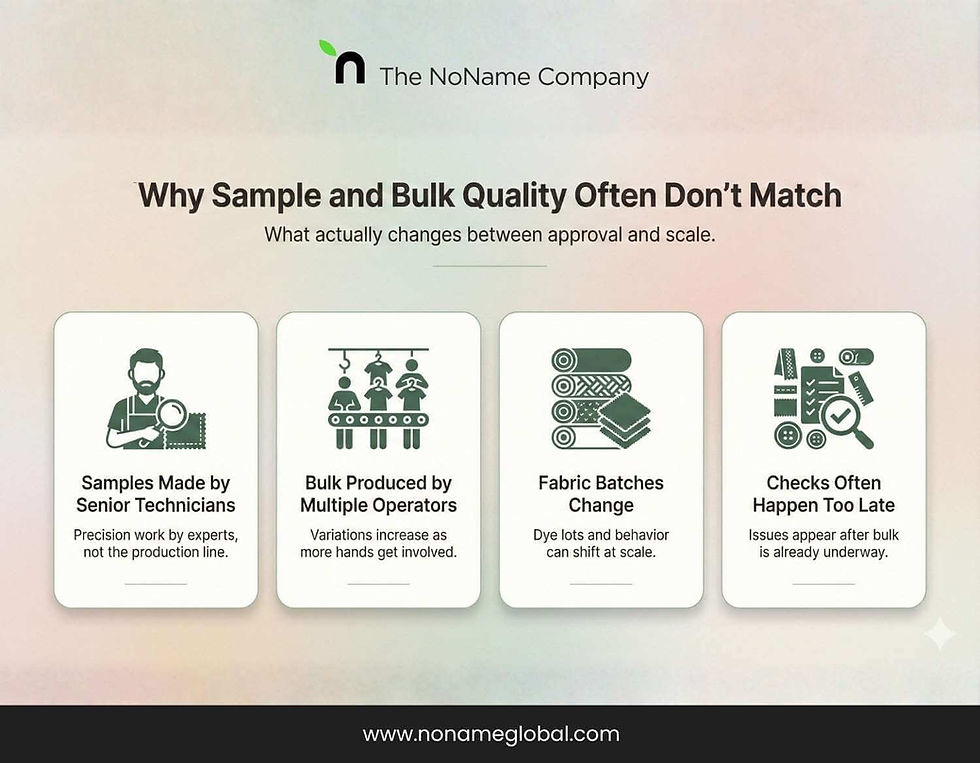
Why Sample and Bulk Quality Often Don’t Match
This gap usually happens because a sample is treated like a showcase piece, while bulk production is treated like a scale operation.
Samples are often made by senior technicians
Bulk is produced by multiple operators
Fabric batches may change
Trims may come from different lots
Quality checks may happen too late
None of this means the manufacturer is careless. It simply means manufacturing at scale needs systems, not assumptions.
What Fashion Brands Should Do To Reduce Sample vs Bulk Issues
To avoid quality issues in sample and bulk production, fashion brands can take a few simple and practical steps themselves, along with partnering with a trusted clothing manufacturer, to reduce bulk order surprises:
Create detailed tech packs: A tech pack is the blueprint of your garment. It should include clear sketches, a complete bill of materials, precise measurements with tolerance levels, construction details, stitching specifications, and packaging instructions. When documentation is clear, ambiguity disappears, and the chances of bulk garments drifting away from the sample drastically reduce.
Provide physical reference samples: Along with digital tech packs, physical reference samples matter. Approved fabric swatches, trims, buttons, labels, and stitching quality samples give the production team a visual benchmark. This helps the factory match the bulk garments to the approved sample more accurately.
Inspect throughout production, not only at the end: Waiting for final inspection is risky. In-line quality checks after major operations such as stitching, printing, embroidery, or washing help catch mistakes early. Fixing errors at this stage is faster, cheaper, and far less painful than fixing finished garments.
Build long-term relationships with manufacturers: Treat manufacturers as partners, not just vendors. Long-term collaboration leads to better communication, stronger trust, and more consistent quality. When a manufacturer understands your brand standards and expectations, the sample-to-bulk gap naturally reduces.
Communicate expectations clearly and realistically: Clear communication does not mean constant follow-ups. Instead, align on updates at key stages like pre-production approval, initial bulk output, and final inspection. This keeps everyone aligned without disrupting the production workflow.
These steps help, but they still require effort, follow-ups, and experience. This is exactly where the right manufacturing partner makes all the difference.
How NoName Ensures Bulk Garments Match the Sample Every Time
NoName is a trusted clothing manufacturer in India for fashion brands. Instead of pushing these responsibilities back to fashion brands, NoName integrates them directly into its manufacturing system.

Premium Fabric Sourcing from Trusted Mills
Consistency starts with fabric. NoName sources fabrics only from trusted and established mills such as Arvind Mills, Raymond, Birla Cellulose, and K G Fabrics, etc.
These mills are known for stable quality, reliable dye lots, and consistent performance.
By locking fabric quality at the source, NoName eliminates one of the biggest causes of bulk variation.
Same Team for Sample and Bulk Production
One of the most overlooked reasons bulk orders fail is when samples and bulk are handled by different teams.
At NoName, the same experienced technicians who develop the sample oversee bulk production.
This ensures that what was approved in the sample is exactly what gets executed in production, without guesswork or interpretation errors.
Streamlined Quality Control That Works at Scale
Quality control at NoName is practical, not theatrical.
Fabric is inspected before production
In-line checks happen during critical operations
Final inspections ensure consistency before shipment
This approach catches problems early without slowing down production or creating unnecessary bottlenecks.
Consistent Trims and Finishing
Buttons, zippers, labels, and other trims are sourced from approved suppliers and checked for consistency.
Placement, finishing, and construction details are monitored closely so bulk garments do not lose the details that made the sample special.

Clear Documentation and Smart Pre-Production Checks
NoName maintains clear, concise documentation for every style.
Instead of burdening brands with endless approvals, NoName uses smart pre-production checks with bulk fabric and trims to ensure alignment before full-scale production begins.
Conclusion
The problem of samples looking perfect while bulk orders fall short is not new. But it is also not inevitable.
With the right systems, premium fabric sourcing, skilled teams, and smart quality control, this issue can be eliminated.
NoName exists to make sure fashion brands never have to choose between speed, scale, and quality. We handle the complexity so your brand can grow with confidence.
If you want your bulk garments to match your sample without stress, delays, or quality compromises, partner with NoName. Let’s build production that your brand can trust, every single time.
FAQs
1. Why does bulk garment production not match the approved sample?
Bulk garment production often differs from the approved sample due to fabric batch variations, different production teams handling bulk orders, inconsistent trims, and insufficient quality checks during production. Samples receive more individual attention, while bulk production requires strong systems to maintain consistency.
2. How can fashion brands ensure bulk garments match the sample?
Fashion brands can ensure consistency by creating detailed tech packs, approving fabric and trims upfront, providing physical reference samples, inspecting garments during production, and working with manufacturers who manage both sample and bulk production under the same quality standards.
3. What role does fabric sourcing play in sample vs bulk quality issues?
Fabric sourcing plays a major role. Different mills or dye lots can cause variations in color, texture, and performance. Using fabrics from trusted mills and maintaining the same fabric batch for both sample and bulk production significantly reduces quality differences.
4. Is in-line quality control better than final inspection?
Yes. In-line quality control is more effective because it identifies issues during production, not after completion. Fixing errors early saves time, reduces costs, and prevents large-scale defects in bulk garment orders.
5. How does NoName ensure bulk garments match the approved sample?
NoName ensures bulk garments match the approved sample by using premium fabrics from trusted mills, assigning the same experienced team to both sample and bulk production, and implementing practical quality control checks at every stage. This system removes guesswork and ensures consistent quality from sampling to shipment.
You can explore these articles also for sampling:
WhatsApp: +91-9717 508 508
Email: hello@nonameglobal.com
Website: www.nonameglobal.com
Online meeting: https://calendly.com/nonameglobal/meet

About the Author
This blog is written by Shraddha Srivastava, a fashion expert and industry observer known for breaking down complex trends into practical, actionable insights. With a strong understanding of garment manufacturing, retail, consumer psychology, and brand strategy, she also brings hands-on knowledge of apparel import–export processes, global compliance, and cross-border sourcing. Shraddha helps fashion brands navigate sourcing, imports, and market expansion, making growth simple, scalable, and data-driven.


Comments