


5 Secret Fabric Sourcing Moves NoName Uses to Scale Your Brand

Updated: Aug 24
Summary
Fabric sourcing is the foundation of successful garment manufacturing, impacting quality, cost, and delivery timelines. By selecting the right mills, testing fabrics, comparing prices, ensuring compliance, and planning risks, NoName creates a reliable sourcing system that helps brands avoid costly mistakes, maintain consistency, and launch collections confidently in competitive markets.
Introduction:
Fabric sourcing may look simple from the outside. Many people think it is just about choosing a fabric and placing an order. But in reality, fabric sourcing is one of the most important stages in garment manufacturing.
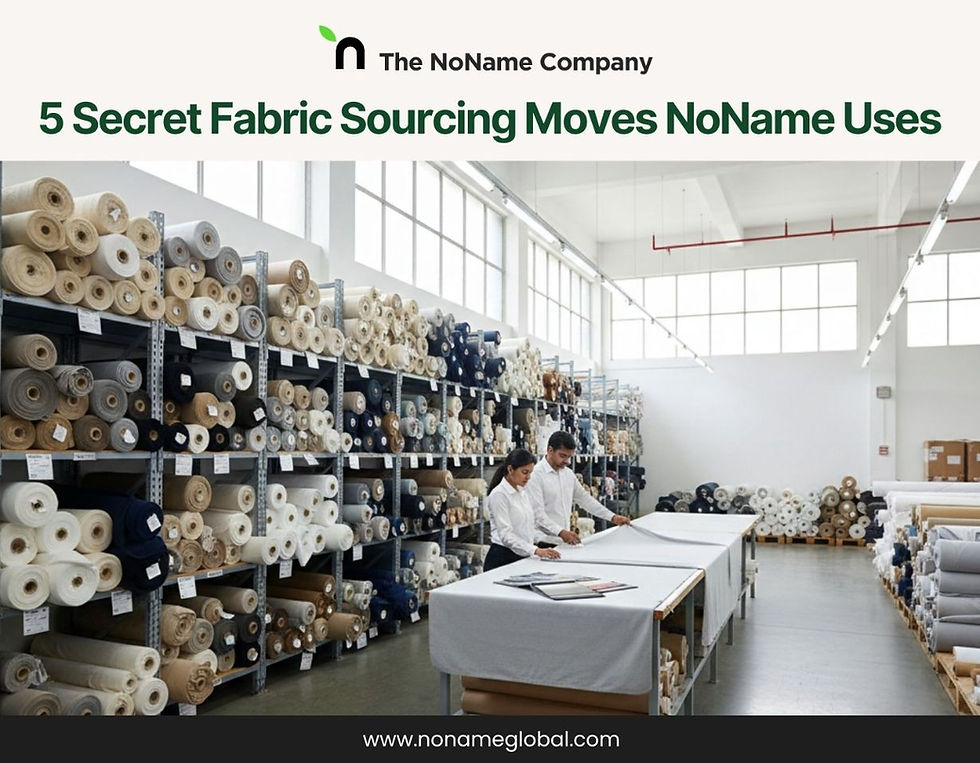
Before your garment is stitched, before your brand label is added, and before your product reaches the store, the fabric decides everything.
If the fabric shrinks too much, the garment size changes.
If the color fades, customers complain.
If the fabric arrives late, your entire launch is delayed.
If certifications are missing, shipments can get stuck.
At NoName, a leading garment manufacturer in India and recently ranked among the Top 10 Textile & Apparel Sourcing Companies 2025, fabric sourcing is not treated as a simple buying task. It is a carefully planned and well-controlled process.
We work closely with leading textile manufacturers such as Arvind Mills, Reliance Denim, KG Denim, Raymond, Siyarams, and Aditya Birla. However, simply working with large mills is not enough. What truly matters is how the entire sourcing process is managed, monitored, and executed.
Here are the five important things NoName does during fabric sourcing to protect your brand.
1. We Choose Mills Based on Knits, Wovens, and Denim
Not every mill is right for every fabric. In textile manufacturing, specialization matters. A knit mill cannot always handle denim properly, and a denim expert may not be the best choice for structured woven fabrics.
At NoName, we select mills based on whether your product requires knits, wovens, or denim.

For knit garments like t-shirts, hoodies, and activewear, we work with mills that specialize in cotton jersey, fleece, and stretch fabrics. These mills have proper knitting and finishing setups to control shrinkage and softness. For example, when a client needed fleece for winter hoodies, we chose a knit mill with in-house brushing to ensure a consistent finish and timely delivery.
For woven garments such as shirts and trousers, we align with mills experienced in structured fabrics like poplin and twill. For premium formalwear, we collaborate with woven specialists like Raymond or Arvind Mills to ensure fabric strength and finish quality.
For denim collections, we work with dedicated denim mills such as Reliance Denim and KG Denim, especially when stretch, indigo consistency, and bulk shade control are critical.
Choosing mills by fabric category helps prevent quality issues and production delays from the start.
2. We Test Fabric Before Bulk Production
A small fabric sample may look perfect, but bulk fabric can behave differently. That is why we test fabric before approving mass production.
We check GSM to confirm the correct weight, shrinkage to see how the fabric reacts after washing, color fastness to prevent fading or bleeding, pilling resistance, and stretch recovery for performance fabrics.
For example, one brand approved a cotton jersey sample with low shrinkage.
During bulk testing, we found higher shrinkage than expected. Because we tested early, we adjusted measurements before cutting began and avoided sizing issues.
In another case, we detected slight color rubbing in a dark shade. The dyeing process was corrected before bulk approval, preventing retailer rejection.
After production, we also conduct garment testing. We test finished pieces for measurement after washing, seam strength, and color fastness to ensure the final product performs as promised.
Testing at both stages protects your quality, sizing accuracy, and brand reputation.
3. We Compare Prices Across Mills
Fabric is usually the biggest cost in garment manufacturing. It can make up more than half of your total garment cost.
That is why we do not depend on one supplier.
We compare prices across multiple approved mills. This helps us understand the real market rate and avoid overpaying.
Raw material prices, especially cotton and polyester, can change quickly.
Sometimes prices rise due to global demand or supply issues. Because we work closely with mills like Arvind Mills and Siyarams, we track market changes and plan.
For example, during a period of rising cotton prices, one supplier increased their quotation suddenly. Since we already had discussions with alternative mills, we secured better pricing elsewhere and protected the client’s margin.
Price benchmarking also gives us backup options. If one mill becomes overbooked, we can shift to another approved mill without delaying production.
This gives your brand stability in both cost and supply.
4. We Check Sustainability and Compliance Carefully
Today, sustainability is not just a marketing claim. It is a requirement.
If your garment is labelled organic or recycled, you must have valid documentation. Without proper certificates, your shipment can be delayed or rejected.
At NoName, we verify certifications such as the Global Organic Textile Standard and the Oeko-Tex.
We check that:
The certificate is valid. The certificate matches your production batch. The supplier details are correct. The documentation aligns with the invoice.
In one situation, a supplier shared a certificate from a previous batch instead of the current one. The difference looked small, but it could have caused customs issues in Europe. We identified the error before shipment and corrected it.
By checking everything carefully, we protect your brand from compliance problems and retailer penalties.
5. We Plan For Risk Before It Happens
Many production delays happen because brands do not fully understand fabric timelines.
Different fabrics require different lead times. Knit fabrics may take a certain number of days for knitting, dyeing, and finishing. Woven fabrics may require separate weaving and processing schedules. Denim often needs additional time for indigo dyeing and quality checks. Yarn availability can also affect the timeline.
At NoName, we clearly inform our customers about the lead time for each specific fabric before production begins. We break down how long knitting or weaving will take, how much time is required for dyeing, and when the fabric will be ready for cutting.
For example, if a stretch denim requires extra processing time, we communicate that in advance so your production calendar is planned correctly. If cotton yarn availability is tight during peak season, we will inform you early and adjust schedules accordingly.
We also manage dye lot continuity. If your collection is delivered in two batches, we ensure both batches use matching dye lots. Even a small shade difference can make garments look inconsistent on the retail rack. By controlling dye lot planning, we maintain uniformity across deliveries.
By sharing accurate lead times and planning, we protect your production schedule and keep your launch timeline secure.
The Final Thought on Fabric Sourcing
At NoName, which is a leading garment manufacturer in India, fabric sourcing is not about finding the cheapest supplier. It is about building a reliable system.
We select the right mills.
We test before production.
We benchmark pricing.
We verify compliance.
We plan for risks.
This structured approach protects your quality, cost, and delivery timeline.
Because in garment manufacturing, fabric is not just a material.
It is the base of your brand.
And when the base is strong, everything built on top of it becomes stronger too.
If you are looking for a sourcing partner who thinks beyond price and focuses on performance, compliance, and long-term growth, NoName is ready to support you.
Let us help you build collections that launch on time, perform consistently, and strengthen your brand in every market you enter.
Reach out to NoName today and build your next collection on a foundation you can trust.
WhatsApp: +91-9717 508 508
Email: hello@nonameglobal.com
Website: www.nonameglobal.com
Online meeting: https://calendly.com/nonameglobal/meet

About the Author
This blog is written by Shraddha Srivastava, a fashion expert and industry observer known for breaking down complex trends into practical, actionable insights. With a strong understanding of garment manufacturing, retail, consumer psychology, and brand strategy, she also brings hands-on knowledge of apparel import–export processes, global compliance, and cross-border sourcing. Shraddha helps fashion brands navigate sourcing, imports, and market expansion, making growth simple, scalable, and data-driven.


Comments