


Polyester For Your Sustainable Brand?

Updated: Sep 19
Summary
Recycled polyester vs virgin polyester decisions depend on garment performance, durability, and lifecycle impact. High-stress products need strength and longevity, while everyday apparel can use recycled blends without compromise. Smart material selection, quality, and longevity reduce the environmental impact of fibre origin, helping fashion brands build scalable, responsible, and high-performing collections.
Introduction
There are many clothing categories where polyester becomes a necessity.
From activewear and leggings to rain jackets, uniforms, and linings, polyester plays a critical role in how these garments perform. It provides strength, moisture management, shape retention, wrinkle resistance, and compatibility with modern manufacturing processes.

However, polyester is petroleum-based and not environmentally friendly. That creates a dilemma for fashion brands. If you want your collection to perform well but also align with sustainability goals, what should you choose?
If you are a fashion brand planning to keep these clothing items in your collection, this guide is for you.
Today, there are alternatives and improvements within the polyester category itself. Recycled polyester (rPET) reduces dependence on virgin petroleum by using post-consumer plastic waste. Several companies are also developing more sustainable innovations, such as biodegradable polyester technologies.
For example, companies like Intrinsic Advanced Materials (CiCLO technology) and Polartec (biodegradable synthetic fabrics) are working on polyester that can break down more effectively in specific environments. While these are not yet commercially available, our hopes are high, and we’re watching these developments closely.
At the same time, stretch materials are also evolving. Brands are investing in eco-conscious stretch fibres such as eco-engineered Lycra and ROICA by Asahi Kasei (Japan), which offer partially plant-based and more responsible stretch fibre solutions.
In this blog, we will explore where polyester is truly required, where recycled polyester makes sense, how sustainable alternatives are developing, and, most importantly, the real applications of each material in different clothing categories.
Because sustainable fashion is not about removing polyester blindly. It is about understanding where and how to use it responsibly.
Here is a shorter, sharper version with a very clear message for fashion brands, fewer bullets, and strong application focus:
Performance Breakdown: Start With the Garment
Many brands ask: “If we switch to recycled polyester, will the performance drop?”
The better question is: What does this garment actually need to handle?
Take a 3-layer rain jacket. It is tightly woven, laminated with a waterproof membrane, seam-sealed, and treated with DWR. It faces rain, friction from backpacks, pulling at seams, and years of wear. In this case, fabric strength and coating stability are critical. For high-performance outerwear meant to last 8–10 years, virgin polyester or chemically recycled polyester often gives more reliable durability.

Now look at a gym T-shirt or leggings. These are knitted, blended with elastane, and heat-set for stretch and recovery. They need flexibility, moisture-wicking, and comfort, not extreme tear strength. In these products, recycled polyester performs very well. Most customers will not notice any difference.
The decision is not about which fibre sounds better. It is about how much stress the garment will face.
The same applies to color. Virgin polyester is more predictable for very bright whites, neons, or strict corporate shades. But for darker colors, prints, and everyday fashion, recycled polyester works perfectly when sourced properly.
First, define the job of the garment. Then choose the fibre.
The Sustainability Paradox: Durability Matters Most
Recycled polyester reduces the use of virgin petroleum. That is important. But sustainability is not just about where the fibre comes from.
All synthetic fabrics shed microfibres over time. The solution is not avoiding recycled polyester. It uses better yarn quality, tighter fabric construction, and proper finishing to reduce shedding.
Now think about outerwear again. If a waterproof jacket peels or delaminates after two seasons, it gets replaced. That cancels out the environmental savings.
A jacket that lasts 10 years is usually more sustainable than one replaced every two years, even if the second one has higher recycled content.
For heavy-use products like ski wear, mountaineering jackets, or workwear, durability must come first.
Lower emissions at the fibre stage do not fix a short product life.
The Power of Blending: Make Clothes Last Longer
The smartest collections are designed to last.
A 100% organic cotton T-shirt feels soft. But after many washes, it may stretch out or lose shape. Adding 15–30% recycled polyester helps the shirt keep its structure, resist wrinkles, and last longer.
The same idea works for:
Linen dresses that crease too easily
Wool sweaters that lose their shape
Cotton joggers that become baggy at the knees
Small amounts of polyester can greatly increase lifespan.
Yes, blended fabrics are harder to recycle. But a garment worn for five years is often better for the environment than one thrown away after one year.
The Message for Fashion Brands
Do not choose fabrics based on trends or pressure.
Choose based on:
How the garment is made
How it will be used
How long should it last
Use recycled polyester where it performs well, such as in activewear and everyday pieces.
Use virgin or chemically recycled polyester where high durability is essential.
Blend fibres when it helps the garment last longer.
The most sustainable garment is not the one with the highest recycled percentage.
It is the one your customer wears for years.
Choosing the Right Fabric for Your Category
Category | Recommended Material | Why? |
Activewear / Leggings | Recycled Polyester (rPET) | Excellent stretch recovery and moisture-wicking. |
Puffer Jackets / Insulated Coats | Virgin or High-End rPET | Requires maximum fibre strength for down-proofing. |
Everyday T-shirts | Organic Cotton / rPET Blend | Combines softness with long-term shape retention. |
Protective Workwear | Virgin Polyester | Non-negotiable safety and abrasion standards. |
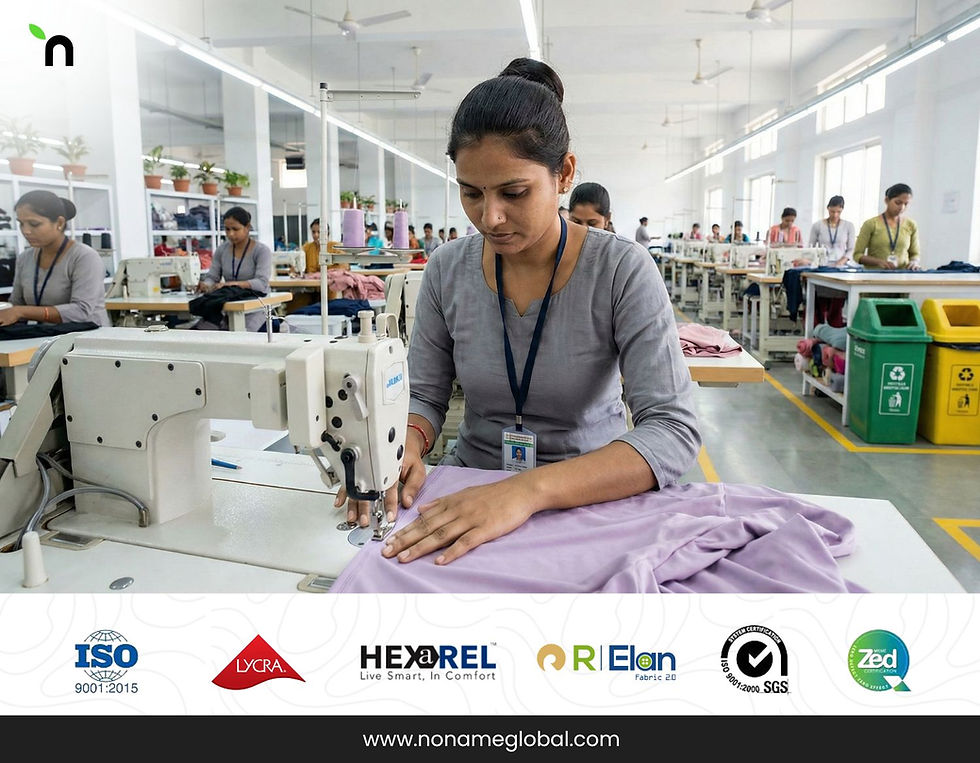
Why "NoName" is Your Strategic Manufacturing Partner For Sustainable Polyester
As a leading sustainable clothing manufacturer in India, NoName doesn't just provide fabric; we provide a material strategy.
We help brands navigate the complex world of textile certifications, including GRS (Global Recycled Standard) and OEKO-TEX. We understand that "one size fits all" doesn't apply to fabric. Our approach involves:
Technical Consulting: We analyze your designs to suggest the best fibre mix for the intended use.
Quality Assurance: We source rPET with the highest filtration standards to ensure a "smooth" hand-feel that rivals virgin polyester.
Longevity Testing: We prioritize "slow fashion" durability, ensuring your brand builds a reputation for quality, not just slogans.
Conclusion: Making the Right Call
Polyester and recycled polyester are tools in a designer’s kit. Neither is "good" nor "bad", they are different.
To build a truly sustainable brand, you must choose the material that ensures the longest possible life for your garment. Use recycled polyester where it performs perfectly (activewear and basics) and use virgin or reinforced fibres where reliability is the key to keeping the garment out of the trash.
Ready to choose the right fabrics for your next collection?
Connect with NoName today to discuss how our sustainable manufacturing expertise can elevate your brand’s quality and impact.
You should explore this guide for Synthetic Fabrics
If you want to explore more articles on Synthetic Fabrics, then you can explore these articles:
WhatsApp: +91-9717 508 508
Email: hello@nonameglobal.com
Website: www.nonameglobal.com
Online meeting: https://calendly.com/nonameglobal/meet

About the Author
This blog is written by Shraddha Srivastava, a fashion expert and industry observer known for breaking down complex trends into practical, actionable insights. With a strong understanding of garment manufacturing, retail, consumer psychology, and brand strategy, she also brings hands-on knowledge of apparel import–export processes, global compliance, and cross-border sourcing. Shraddha helps fashion brands navigate sourcing, imports, and market expansion, making growth simple, scalable, and data-driven.


Comments