


10 Mistakes in Hoodie Manufacturing That Can Cost Fashion Startups

Updated: Aug 14
Nothing hurts a new brand faster than opening customer feedback to read that your hoodies shrank in the wash or lost their stretch within a week.
Many founders assume that marketing is the toughest hurdle, but production is where the real test lies.
Because hoodies combine heavy fabrics, structured ribbing, pockets, and drawcords, they are far more complex to build than a basic tee. One small oversight can ruin the entire batch.
Fortunately, you can prevent these issues before they start. Knowing the common mistakes in hoodie manufacturing protects your investment, saves you from costly redesigns, and ensures you deliver the durable, high-quality products your customers expect from day one.
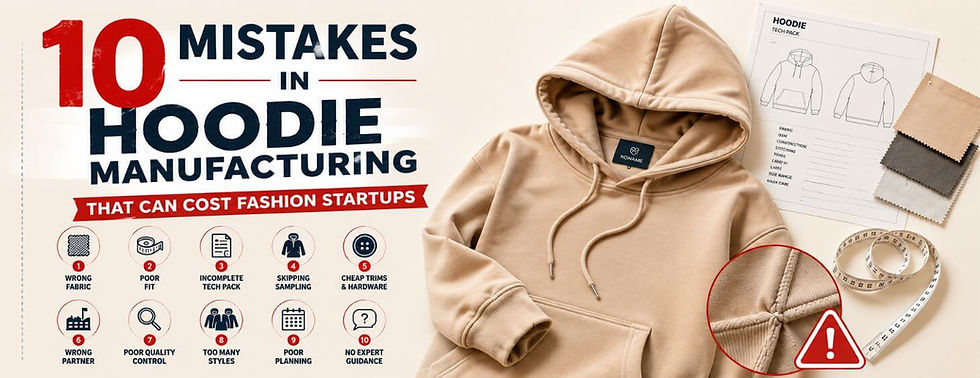
Hoodie Manufacturing Mistakes at a Glance
Mistake | What Happens | How to Avoid It |
Choosing the wrong fabric | Poor comfort and high returns | Select fabric based on purpose, not just GSM |
Ignoring fit development | Customers complain about sizing | Test multiple fit samples |
Incomplete tech pack | Production mistakes | Create detailed manufacturing specifications |
Skipping sampling | Expensive production errors | Approve at least two to three sample rounds |
Cheap trims and hardware | Hoodie looks low quality | Invest in premium components |
Lowest-price manufacturer | Delays and inconsistent quality | Choose experience over cheap pricing |
Poor quality control | Defective products reach customers | Conduct inspections before shipping |
Complicated first collection | High inventory costs | Start with fewer, better products |
Poor production planning | Missed launch dates | Build realistic timelines |
No manufacturing guidance | Costly mistakes | Work closely with an experienced manufacturer |
Now let's look at these mistakes in detail.
1. Choosing Fabric Based Only on GSM
One of the biggest mistakes in hoodie manufacturing is assuming that a higher GSM always means better quality.
In reality, a 400 GSM hoodie made with low-quality yarn can perform worse than a well-made 320 GSM hoodie.
Fabric composition, knit structure, and finishing are equally important. For example, premium streetwear brands in 2026 often use 380 to 500 GSM fabrics, but they also test for softness, shrinkage, and durability before production.
2. Ignoring Fit Development
A great-looking hoodie can still fail if it doesn't fit well. Many startups simply copy measurements from another brand instead of developing their own pattern.
This often leads to twisted sleeves, tight shoulders, or oversized hoods. Customers may forgive a delayed launch, but they rarely forgive a poor fit.
Test multiple fit samples on different body types before approving production.
3. Treating the Tech Pack Like a Formality
A hoodie tech pack is your production blueprint. Sending only reference images leaves too much room for interpretation.
Your tech pack should include measurements, fabric details, stitching, ribbing, hood dimensions, trims, labels, and artwork placement.
A detailed tech pack prevents expensive mistakes in hoodie manufacturing and ensures every sample matches your vision.
4. Skipping Sampling to Save Money
Approving the first sample to save time is one of the costliest mistakes.
A hoodie may look perfect in photos but shrink after washing, lose its shape, or feel uncomfortable when worn.
Always request at least a Fit Sample and a Pre-Production Sample, then wear and wash them before giving final approval.
5. Ignoring the Small Details
Customers notice the little things more than you think. Loose eyelets, fraying drawcords, stretched ribbing, or poor-quality aglets can make a premium hoodie feel cheap.
Reinforced pocket corners, durable stitching, and quality trims improve both durability and customer perception.
Sometimes, the smallest details create the biggest impression.
6. Choosing the Cheapest Manufacturer
Low manufacturing costs may look attractive, but they often come with hidden compromises.
Some factories substitute fabrics, reduce quality checks, or miss deadlines to meet low prices.
Instead of choosing the cheapest quote, look for a manufacturer with strong sampling, quality control, and product development expertise.
A reliable manufacturing partner saves more money in the long run than a cheap one.
7. Ignoring Quality Control
Quality control should happen throughout production, not after the hoodies are packed. Imagine receiving 2,000 hoodies with uneven stitching or incorrect sizing.
Fixing those issues later can be extremely expensive. Many successful brands use AQL inspections before shipment to identify defects early.
Preventing one production mistake is far easier than handling hundreds of customer complaints.
8. Launching Too Many Styles
Many fashion startups launch with multiple hoodie styles, colours, and fabrics, hoping to attract more customers. Instead, they increase inventory costs and production complexity.
Several successful streetwear brands began with just one signature hoodie before expanding their collections.
Focus on creating one exceptional product before adding more styles.
9. Poor Production Planning
Many founders underestimate how long hoodie manufacturing takes.
Fabric sourcing, dyeing, sampling, printing, stitching, quality checks, and shipping all require time. Even a two-week delay in fabric approval can postpone an entire launch.
In 2026, with growing demand for premium hoodies, planning your production schedule early is more important than ever.
10. Treating Manufacturing as a Transaction
The final and perhaps most overlooked mistake in hoodie manufacturing is treating your manufacturer as just a supplier.
An experienced manufacturer can recommend better fabrics, improve fit, suggest cost-saving construction methods, and identify production risks before they become expensive problems.
The best hoodie brands are built through collaboration, not just manufacturing.

Fashion Startups Trust NoName for Hoodie Manufacturing Without Mistakes
Starting a hoodie brand should be exciting, not stressful. At NoName, we've seen many fashion startups come to us after facing challenges with their first manufacturer. Some received hoodies that shrank after washing.
Others struggled with inconsistent sizing, poor-quality fabrics, delayed deliveries, or products that looked nothing like the approved sample.
That's why NoName follows a product development approach instead of simply a production approach.
As one of the best hoodie manufacturers in India, we help fashion startups at every stage of the journey.
From selecting the right fabric and developing custom patterns to creating detailed tech packs, producing samples, sourcing premium trims, and maintaining strict quality control, our team ensures every hoodie is built for long-term success.
We also guide brands in choosing the right GSM, fit, fabric construction, printing techniques, branding elements, and production methods based on their target customers and business goals.
Whether you're launching your first streetwear label or scaling an established fashion brand, our advice helps you avoid costly manufacturing mistakes before they happen.
Conclusion
Building a successful hoodie brand isn't about finding the cheapest fabric or the fastest manufacturer. It's about making smart decisions from the very beginning.
Every manufacturing decision shapes your customer's experience. The fabric they touch, the fit they wear, the stitching they notice, and the quality they experience all determine whether they become repeat customers or leave negative reviews.
The good news is that these mistakes are completely avoidable when you work with the right manufacturing partner.
If you're looking for a trusted hoodie manufacturer in India that understands fashion startups, offers expert guidance, flexible manufacturing, premium quality, and end-to-end product development, NoName is ready to help.
From your first sketch to your final shipment, we'll help you create hoodies that stand out in the market and keep your customers coming back for more.
Frequently Asked Questions
1. What is the biggest mistake fashion startups make in hoodie manufacturing?
The biggest mistake is focusing only on price instead of product development. Choosing the wrong fabric, skipping sampling, or working with an inexperienced manufacturer often leads to quality issues, customer complaints, and expensive rework.
2. What GSM is best for premium hoodies in 2026?
For premium streetwear and lifestyle brands, 380 GSM to 500 GSM remains one of the most popular ranges in 2026. However, the ideal GSM depends on your target market, climate, and intended use. Fabric quality, construction, and finishing are just as important as GSM.
3. How many hoodie samples should I approve before bulk production?
Most manufacturers recommend at least two or three sampling stages, including a Fit Sample and a Pre-Production Sample. Wearing and washing these samples helps identify fit, shrinkage, and construction issues before full-scale production.
4. How do I choose the right hoodie manufacturer?
Look beyond pricing. Evaluate the manufacturer's experience, sampling process, quality control system, communication, production capabilities, and ability to provide product development support. A reliable manufacturer acts as a long-term partner rather than just a supplier.
5. Why should fashion startups work with NoName?
NoName helps fashion startups manufacture premium custom hoodies without common production mistakes. We provide expert guidance on fabrics, fits, sampling, branding, quality control, and manufacturing, helping brands launch confidently while maintaining high product quality.

You should explore this comprehensive Guide on Custom Hoodie Manufacturing
You can explore more in this article:
You can explore more in these articles about hoodies:
WhatsApp: +91-9717 508 508
Email: hello@nonameglobal.com
Website: www.nonameglobal.com
Online meeting: https://calendly.com/nonameglobal/meet
About the Author
This blog is written by Shraddha Srivastava, a fashion expert and industry observer known for breaking down complex trends into practical, actionable insights. With a strong understanding of garment manufacturing, retail, consumer psychology, and brand strategy, she also brings hands-on knowledge of apparel import–export processes, global compliance, and cross-border sourcing. Shraddha helps fashion brands navigate sourcing, imports, and market expansion, making growth simple, scalable, and data-driven.


Comments