


Custom Hoodie Manufacturing Guide 2026 for Fashion Brands

Updated: Aug 29
The hoodie has evolved into one of the most important product categories in modern fashion. In 2026, it is no longer just a comfort garment.
It is a brand identity product, a core streetwear essential, and a high-margin category for both emerging and established fashion labels.
If you are searching for custom hoodie manufacturing, private label hoodie manufacturing in India, or a reliable hoodie production partner for your fashion brand, understanding how the process works is essential before you place your first order.
A successful hoodie collection is built on decisions that go far beyond design.
Fabric selection, silhouette direction, GSM weight, construction quality, and manufacturing capability all determine how your product performs in the market.
This guide breaks down everything fashion brands need to know about custom hoodie manufacturing in 2026, from trend direction to production execution.
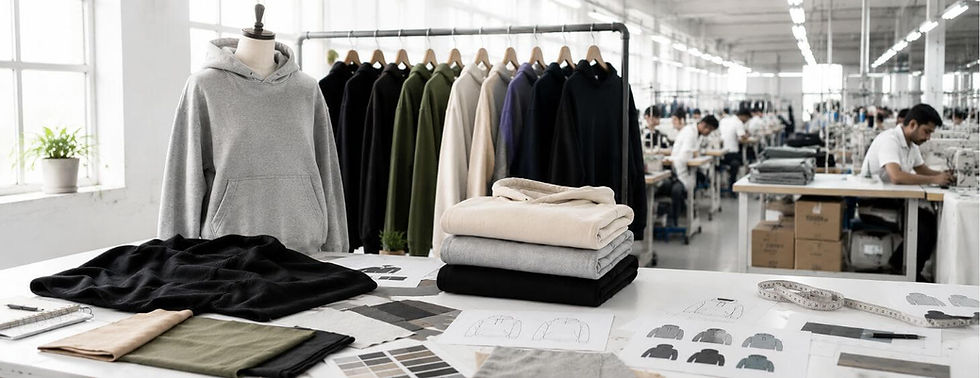
Want to launch your Hoodie Collection? Then click here
Quick Summary: Hoodie Manufacturing 2026 Overview
Area | Key Insight for Fashion Brands |
Silhouette Trends | Oversized, boxy, drop-shoulder fits dominate 2026 fashion markets |
Branding Style | Shift toward minimalist, tonal, and hidden branding instead of loud logos |
Fabric Choices | 100% cotton, cotton-poly blends, and sustainable fabrics (GOTS, rPET) are leading options |
GSM Range | 320–380 GSM is the commercial sweet spot; 380+ GSM for premium streetwear |
Hoodie Construction | Three-panel hoods, ribbed cuffs, and structured patterns define premium quality |
Customization | Screen print, DTF, embroidery, and puff print based on brand positioning |
Production Timeline | Typically 2 to 6 weeks including sampling and bulk manufacturing |
MOQ Strategy | Ranges from low MOQ testing batches to 100–500+ units for full custom production |
Key Success Factor | Choosing the right manufacturer determines quality, consistency, and scalability |
The Hoodie Market: What Fashion Brands Need to Know Before Manufacturing
The global hoodie market has shifted significantly in recent years, and 2026 marks a clear maturity point where product quality and brand positioning matter more than ever.
The strongest trend shaping the industry is the dominance of oversized hoodie silhouettes.
Fashion brands are increasingly moving away from slim or fitted hoodies and adopting relaxed, boxy proportions that align with modern streetwear and luxury casualwear aesthetics.
In most premium collections today, chest widths are increased by 10 to 15 centimetres compared to traditional fits.
Drop shoulders are now standard, and elongated body lengths create a more relaxed drape.
Cropped hoodies have also gained traction, particularly in women’s fashion and youth-focused streetwear collections.
These shifts are driven by changing consumer expectations where comfort, individuality, and gender-neutral styling play a major role.
Alongside silhouette evolution, branding styles have also changed. The era of oversized logos and loud front graphics is fading.
Modern fashion brands now prefer minimalist branding approaches, such as tonal embroidery, subtle chest placement, sleeve detailing, or even fully unbranded hoodies.
This reflects a shift toward premium positioning where fabric quality and fit carry more weight than visible logos.
Another emerging factor influencing custom hoodie manufacturing for fashion brands is digital traceability.
With global markets moving toward transparency standards, many brands now require manufacturers to support Digital Product Passports (DPPs).
These systems track material origin, production processes, and sustainability compliance, especially for brands selling in European and premium D2C markets.
Fabric Selection in Custom Hoodie Manufacturing: The Foundation of Product Quality
Fabric selection is one of the most critical decisions in hoodie production because it directly influences comfort, durability, pricing, and brand perception.
In custom hoodie manufacturing, fabric is not just a material choice but a strategic positioning tool.
The most widely used fabric option remains 100 per cent cotton fleece. It is known for its natural softness, breathable structure, and premium hand feel.
It also provides a strong drape that works exceptionally well for oversized silhouettes.
However, cotton fabrics require careful handling because they can shrink by approximately 5 to 8 per cent if not pre-treated before production.
The second most common option is the 80/20 cotton polyester blend.
This fabric has become the industry standard for scalable hoodie production because it balances durability with comfort.
It offers better shape retention, reduced shrinkage, and improved wash stability.
For many fashion brands, especially those operating in the D2C or streetwear segment, this blend provides the best cost-to-quality ratio.
In 2026, sustainability has also become a major driver in fabric sourcing decisions.
Many fashion brands now actively choose GOTS-certified organic cotton, recycled cotton fabrics, and rPET polyester blends.
These materials help brands align with global sustainability expectations while also improving brand storytelling and retail positioning.
Fabric weight, measured in GSM or grams per square meter, is equally important.
Lightweight hoodies typically fall in the range of 280 to 320 GSM and are suitable for layering and athleisure collections.
Midweight hoodies between 320 and 380 GSM represent the most commercially successful category because they offer year-round usability.
Heavyweight hoodies above 380 GSM are widely used in premium streetwear collections where structure, durability, and luxury feel are key selling points.
Interior fabric construction also impacts comfort and positioning. French terry fabric provides a smooth outer surface with looped interiors, making it breathable and lightweight.
In contrast, brushed fleece offers a soft, insulated interior, making it ideal for winter collections and premium heavyweight garments.
Hoodie Construction and Fit Engineering in Modern Manufacturing
One of the most overlooked aspects of custom hoodie manufacturing in India and global markets is garment construction.
While fabric and design attract attention, construction quality determines long-term customer satisfaction.
The hood structure is a defining element.
A standard hoodie uses a two-panel hood, which is simple, functional, and cost-effective.
However, premium fashion brands often choose a three-panel hood because it provides better shaping, improved structure, and a more rounded silhouette.
Many high-end hoodies also include double-layer hoods, which increase weight and improve drape quality.
Pocket design also plays an important role in defining hoodie identity. The traditional kangaroo pocket remains widely used for its functionality and streetwear appeal.
However, many modern fashion brands now prefer side seam hidden pockets for a cleaner, minimalist aesthetic. In high-fashion inspired collections, pocketless hoodies are also becoming more common because they emphasize silhouette and fabric over utility.
Small finishing details significantly impact perceived value. Rib construction is one such detail.
While 1x1 ribbing is standard in basic hoodies, 2x2 ribbing provides a thicker, more structured appearance that aligns with premium positioning.
Drawcords also contribute to overall quality perception, with flat cotton cords and metal aglets being preferred in higher-end collections.
Pattern making and size grading are equally important in hoodie manufacturing. Proper grading ensures that oversized fits remain consistent across sizes.
Unlike simple scaling, professional manufacturers adjust proportions based on garment measurements, fabric behavior, and shrinkage factors.
This ensures that every size maintains design integrity and wearable consistency.
Customization Techniques in Custom Hoodie Manufacturing
Customization is where fashion brands define their identity in custom hoodie manufacturing for fashion labels.
The choice of decoration method affects aesthetics, durability, and production cost.
Screen printing remains one of the most widely used methods due to its cost efficiency and vibrant color output.
It is ideal for bold graphics and bulk production runs, although it is less effective for complex or highly detailed artwork.
Direct-to-film (DTF) printing has become increasingly popular in 2026 due to its flexibility.
It supports multi-color designs, photographic details, and small batch production without requiring color separation setups.
This makes it suitable for emerging fashion brands testing new designs.
Embroidery is widely used in premium hoodie collections. It creates a textured, durable finish that communicates luxury and long-term value.
However, embroidery costs increase with stitch complexity, making it more suitable for minimal branding rather than large graphics.
Puff printing has gained strong popularity in streetwear fashion. It creates a raised, three-dimensional effect that enhances visual impact.
However, it requires heavier GSM fabrics to maintain structure and avoid distortion.
Each customization technique should align with brand positioning rather than just design preference.
A premium brand should prioritize embroidery and minimal detailing, while a streetwear brand may lean toward puff print and bold graphics.
The Custom Hoodie Manufacturing Process Explained
The production cycle in custom hoodie manufacturing typically takes between 2 to 6 weeks depending on complexity, fabric availability, and order size.
The process begins with tech pack development, where all design specifications are documented.
This includes measurements, construction details, stitch types, fabric selection, and branding placements.
A strong tech pack reduces production errors and ensures accurate sampling.
Next comes fabric sourcing and pre-treatment, where the selected fabric is sourced from mills and pre-washed to control shrinkage and ensure consistency.
After this, manufacturers create a sample hoodie, which is reviewed by the brand for fit, quality, and design accuracy.
Once the sample is approved, bulk production begins. This involves fabric cutting, stitching, printing or embroidery, and assembly.
After production, each hoodie undergoes strict quality control checks, including seam strength testing, size verification, color consistency evaluation, and defect inspection.
Finally, garments are finished with branding elements such as woven labels, hangtags, and packaging before dispatch.
MOQ, Pricing, and Manufacturing Strategy for Fashion Brands
Fashion brands typically choose between two manufacturing models in custom hoodie manufacturing in India and global markets.
Low MOQ production is ideal for testing designs and market demand. It allows brands to start with smaller batches using pre-developed blanks or simplified manufacturing setups.
However, customization options may be limited.
Fully custom cut-and-sew manufacturing provides complete control over fabric, fit, and branding.
This model is preferred by serious fashion brands building long-term collections, but it usually requires minimum order quantities between 100 and 500 units per style.
Pricing depends on multiple factors including fabric GSM, material type, decoration method, stitching complexity, custom trims, packaging, and order volume.
Larger production runs significantly reduce per-unit costs due to economies of scale.
Why NoName is a Trusted Partner for Custom Hoodie Manufacturing in India
For fashion brands exploring custom hoodie manufacturing in India, choosing the right production partner is one of the most important decisions in building a successful clothing line.
NoName has positioned itself as a trusted hoodie manufacturer in India by focusing on consistent quality, scalable production systems, and brand-oriented manufacturing support.
NoName specializes in modern hoodie production, including oversized silhouettes, private label hoodie manufacturing, and premium fabric sourcing.
Instead of functioning as a traditional factory, it works closely with fashion brands to develop products that align with their identity and market positioning.
From sampling to bulk production, NoName ensures that every hoodie reflects the brand’s intended quality and design direction.
This reduces production risks for emerging fashion labels and helps established brands maintain consistency across collections.
Conclusion: Building a Successful Hoodie Brand with the Right Manufacturing Partner
The hoodie category in 2026 offers massive opportunity for fashion brands, but it also demands precision in execution.
Success in custom hoodie manufacturing depends on understanding fabric selection, silhouette trends, construction quality, and production workflows.
A well-made hoodie is not just a garment. It is a long-term representation of your brand identity.
If you are planning to launch or scale your hoodie collection, your manufacturing partner will directly influence your product quality and market success.
The right partner ensures consistency, scalability, and premium execution at every stage of production.
For fashion brands looking for custom hoodie manufacturing in India, private label hoodie production, and a reliable manufacturing partner, NoName offers the expertise and production capability needed to bring your vision to life.
Reach out to NoName today and start building your next hoodie collection with confidence, precision, and premium manufacturing excellence.
Frequently Asked Questions (FAQs)
1. What is custom hoodie manufacturing for fashion brands?
Custom hoodie manufacturing is the process where fashion brands design and produce hoodies based on their own specifications, including fabric, fit, GSM, branding, and construction details. It allows brands to create private label hoodies, streetwear collections, and premium apparel lines that reflect their unique identity instead of using pre-made garments.
2. What is the minimum order quantity (MOQ) for custom hoodie manufacturing?
The MOQ depends on the type of manufacturing. Low MOQ production using blank-based hoodies can start from small batches for testing collections. However, fully custom cut-and-sew hoodie manufacturing typically requires 100 to 500+ units per style, depending on fabric, customization, and manufacturer capabilities. Larger orders usually reduce per-unit cost significantly.
3. Which fabric is best for custom hoodie manufacturing in 2026?
The best fabric depends on brand positioning. 100% cotton fleece is ideal for premium fashion brands, while 80/20 cotton polyester blends are preferred for scalable streetwear production. French terry is used for lightweight modern hoodies, and brushed fleece is best for winter and heavyweight collections. Sustainable options like organic cotton and recycled fabrics are also gaining strong demand in 2026.
4. How long does hoodie manufacturing take from sampling to production?
The full custom hoodie manufacturing process typically takes 2 to 6 weeks. This includes tech pack development, fabric sourcing, sample creation, approval stages, and bulk production. Timelines may vary depending on fabric availability, design complexity, order size, and customization methods such as embroidery or printing.
5. How do fashion brands choose the right hoodie manufacturer?
Fashion brands should evaluate manufacturers based on sampling capability, fabric sourcing quality, production consistency, customization options, and communication reliability. A strong custom hoodie manufacturer should also support scaling, provide fabric guidance, and ensure consistent quality across all production batches, especially for oversized and premium hoodie collections.

You should explore more about Custom Hoodie Manufacturing in this article:
WhatsApp: +91-9717 508 508
Email: hello@nonameglobal.com
Website: www.nonameglobal.com
Online meeting: https://calendly.com/nonameglobal/meet
About the Author
This blog is written by Shraddha Srivastava, a fashion expert and industry observer known for breaking down complex trends into practical, actionable insights. With a strong understanding of garment manufacturing, retail, consumer psychology, and brand strategy, she also brings hands-on knowledge of apparel import–export processes, global compliance, and cross-border sourcing. Shraddha helps fashion brands navigate sourcing, imports, and market expansion, making growth simple, scalable, and data-driven.


Comments