


How We Manufacture Premium Hoodies: A Behind-the-Scenes Look for Fashion Brands

Updated: Sep 5
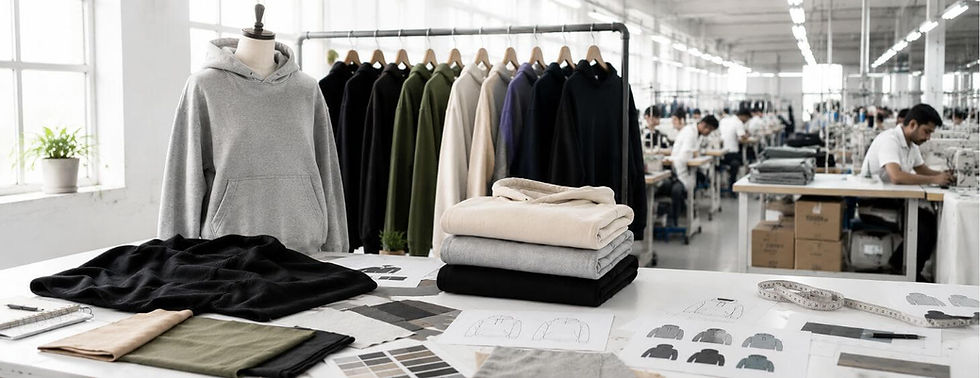
Every hoodie starts as an idea. It could be a sketch in a notebook, a mood board filled with inspiration, or a vision for the next best-selling streetwear collection.
However, transforming that idea into a high-quality garment requires a structured hoodie product development process that combines
creativity,
technical expertise, and
manufacturing precision.
At NoName, we believe that successful hoodie manufacturing is about much more than cutting fabric and sewing panels together.
Every hoodie undergoes a carefully planned development process that ensures the final product reflects the brand's vision while meeting modern consumers' quality expectations.
Whether you are building a premium streetwear label, a sustainable fashion brand, or an everyday essentials collection, understanding how hoodies are developed can help you make smarter production decisions and create products that customers genuinely love.

Want to launch your Hoodie Collection? Then click here
Quick Summary: Our Hoodie Development Process
Stage | Purpose | Outcome |
Brand Consultation | Define goals and target audience | Clear product direction |
Fabric Development | Select materials, construction, and GSM | Desired comfort and performance |
Pattern Development | Create the garment blueprint | Accurate fit and silhouette |
Construction Planning | Finalise hoodie details | Premium functionality and aesthetics |
Sampling | Test and refine the product | Production-ready prototype |
Bulk Manufacturing | Scale production | Consistent quality |
Quality Control | Inspect every stage | Reliable finished garments |
Packaging & Dispatch | Prepare for delivery | Retail-ready hoodies |
Step 1: Understanding the Brand Before Developing the Hoodie
The first step in our process is understanding the brand itself.
Many people assume hoodie manufacturing starts with fabric selection, but it actually begins with understanding who will wear the garment.
A hoodie designed for a luxury streetwear customer requires a completely different development approach than one created for an athleisure or sustainable fashion brand.
At NoName, we spend time understanding the brand's
target audience,
pricing strategy,
market positioning, and
product goals.
These insights help us recommend the right materials, fit, construction techniques, and customisation methods.
This stage creates the foundation for the entire product development process.
Step 2: Selecting the Right Fabric for the Collection
Fabric is one of the most important decisions in hoodie manufacturing because it directly impacts comfort, appearance, durability, and perceived value.
When developing a hoodie, we first determine the most suitable fibre composition.
Depending on the brand's goals, this may include 100% cotton, organic cotton, cotton-polyester blends, recycled cotton, or bamboo viscose blends.
The next decision involves selecting the appropriate fabric construction.
Some brands prefer French terry because of its lightweight feel and year-round versatility.
Others choose brushed fleece for its warmth, softness, and premium streetwear appeal.
Finally, we determine the ideal GSM (Grams per Square Meter).
Lightweight hoodies typically fall between 280 and 320 GSM, while premium streetwear collections often use 380 to 450 GSM heavyweight fleece to create a structured silhouette and luxurious feel.
The right fabric combination plays a major role in defining the customer experience.
Step 3: Developing the Hoodie Pattern
Once the fabric has been finalized, the focus shifts to pattern development.
A pattern serves as the blueprint of the garment. It determines the hoodie's shape, proportions, and overall fit.
Every measurement, from shoulder width and sleeve dimensions to body length and hood size, is established during this stage.
This process has become increasingly important as oversized fits continue to dominate fashion trends.
Creating an oversized hoodie is not simply about increasing measurements. It requires careful engineering to ensure the garment maintains balance, structure, and proportion.
At NoName, we develop patterns specifically around the desired silhouette, helping brands achieve the exact fit they envision.
Step 4: Refining the Construction Details
This is where a hoodie begins to develop its unique identity.
The details that customers may never consciously notice often become the features that define product quality.
Elements such as
hood construction,
pocket design,
ribbing, drawcords, and
all contribute to the overall look and feel of the garment.
Many premium collections use a three-panel hood rather than a standard two-panel construction.
This creates a fuller shape and a more structured appearance. Double-layer hoods are also commonly used to add weight and improve drape.
Pocket design is another important consideration. While traditional kangaroo pockets remain popular, many modern fashion brands now prefer side-seam or hidden pockets to achieve a cleaner, more minimal aesthetic.
These details help transform a basic hoodie into a premium product.
Step 5: Creating and Testing Samples
Before production begins, we create physical samples for evaluation.
Sampling is one of the most valuable stages in hoodie product development because it allows brands to experience the garment before committing to bulk production.
During this stage, we evaluate
fit,
comfort,
construction quality,
branding placement,
fabric performance, and
overall appearance.
Small adjustments can significantly improve the final product.
A slightly deeper hood, a wider cuff, or a different pocket position can completely change how a hoodie feels and functions.
Many successful collections go through multiple sample revisions before final approval.
Step 6: Manufacturing the Hoodie Collection
Once the sample has been approved, the project moves into bulk production.
The process begins with fabric inspection to ensure consistency in colour, GSM, and quality.
Patterns are then digitised and arranged to optimise fabric utilisation before cutting begins.
After cutting, each garment progresses through a series of specialised sewing operations.
Panels are assembled, sleeves are attached, hoods are constructed, ribbing is applied, and labels are inserted.
Branding elements such as screen printing, embroidery, DTF transfers, or puff printing are then applied based on the project's specifications.
Every stage is monitored to maintain consistency across the production run.
Turning a Hoodie Into a Brand: Customization That Creates Identity
A well-constructed hoodie is only the starting point. What truly separates a premium fashion brand from the crowd is how it uses customization to create a unique product experience.
At NoName, this is where the creative side of custom hoodie manufacturing comes to life.
Once the hoodie body is developed, brands can customize nearly every component to reflect their identity.
A simple hoodie can be transformed through custom trims, branded hardware, speciality printing techniques, embroidery, woven patches, labels, and packaging details. These elements may seem small individually, but together they create a product that feels distinctly yours.
For example, a minimalist luxury brand may choose
tonal embroidery,
matte metal aglets,
hidden labels, and
premium woven neck tapes
to create a refined aesthetic.
A streetwear brand may opt for
oversized puff prints,
rubber patches,
distressed washes, and
custom drawcords
to create a bold statement piece.
Even the zipper can become a branding opportunity.
Many fashion brands now invest in
custom zipper pullers,
engraved metal hardware,
branded snaps, and
personalized cord ends
that reinforce brand recognition every time the garment is worn.
The same applies to labelling. Instead of standard manufacturer labels, brands increasingly use
custom woven labels,
satin care labels,
heat-transfer neck labels,
QR-code labels, and
Digital Product Passport integrations
that tell a deeper brand story.
For premium collections, additional customization options include
chenille patches,
silicone badges,
leather patches,
high-density prints,
reflective graphics,
appliqué embroidery,
contrast stitching,
garment dyeing, and
vintage wash effects.
These details often influence purchasing decisions more than brands realize.
Customers may not consciously notice every element, but they immediately recognize when a hoodie feels thoughtfully designed and genuinely premium.
At NoName, we work closely with fashion brands during product development to ensure every customization choice supports the
brand's positioning,
target audience, and
price point.
Our goal is not simply to manufacture hoodies but to help brands create products that customers instantly recognize and remember.
Step 7: Quality Control and Finishing
Quality control is integrated throughout the manufacturing process rather than being treated as a final step.
At NoName, every hoodie is checked for
measurement accuracy,
stitch consistency,
fabric quality,
logo placement, and
overall construction standards.
This helps ensure that every garment meets the specifications approved during development.
After inspection, the hoodies move through finishing processes that include pressing, folding, labeling, packaging, and shipment preparation.
These final touches help create a professional customer experience while protecting the product during transit.
Why Fashion Brands Choose NoName
Developing a successful hoodie requires more than manufacturing capacity. It requires expertise in fabrics, fit development, construction techniques, and production management.
As a leading hoodie manufacturer in India, NoName helps fashion brands navigate every stage of the development process.
From selecting the right hoodie fabrics, engineering the perfect fit, creating production-ready samples, and managing large-scale manufacturing, our team works closely with brands to transform ideas into market-ready products.
Whether you are launching a new collection or expanding an existing product line, we focus on creating hoodies that combine quality, comfort, durability, and strong commercial appeal.
Conclusion
The best hoodies are not created during production. They are created during development.
Every decision, from selecting the right fabric and engineering the fit to refining construction details and testing samples, shapes the final customer experience.
Brands that invest in hoodie construction and product development consistently create stronger products and build greater customer loyalty.
At NoName, we guide fashion brands through every stage of custom hoodie manufacturing, helping transform concepts into premium products ready for the market.
If you are planning your next hoodie collection, connect with NoName today and discover how expert product development can help bring your vision to life.
FAQs
1. What is the hoodie product development process?
The hoodie product development process involves several stages, including concept creation, fabric selection, pattern development, construction planning, sample production, bulk manufacturing, and quality control. Each step ensures the final hoodie meets the brand's design, fit, quality, and performance requirements.
2. Why is pattern development important in custom hoodie manufacturing?
Pattern development determines the fit, silhouette, and proportions of a hoodie. A well-engineered pattern ensures consistency across all sizes and helps fashion brands achieve specific styles such as oversized, relaxed, cropped, or regular-fit hoodies.
3. How long does it take to develop and manufacture custom hoodies?
The timeline typically ranges from 3 to 8 weeks, depending on fabric availability, sample revisions, customization requirements, and order quantity. Product development and sampling usually take 1 to 3 weeks, while bulk production can take an additional 2 to 5 weeks.
4. What factors affect the quality of a custom hoodie?
Several factors influence hoodie quality, including fabric selection, GSM, construction techniques, stitching quality, hood design, ribbing, trims, and quality control processes. Premium hoodies often use heavyweight fabrics, reinforced seams, and carefully engineered fits to improve durability and comfort.
5. What should fashion brands look for in a hoodie manufacturer?
Fashion brands should look for a manufacturer with expertise in product development, fabric sourcing, patternmaking, sampling, customisation, and quality assurance. An experienced custom hoodie manufacturer can help optimize fit, reduce production errors, and ensure consistent quality across every order.

You should explore this comprehensive Guide on Custom Hoodie Manufacturing
You can explore more in this article:
You can explore more in these articles about the manufacturing of different aspects of hoodies:
WhatsApp: +91-9717 508 508
Email: hello@nonameglobal.com
Website: www.nonameglobal.com
Online meeting: https://calendly.com/nonameglobal/meet
About the Author
This blog is written by Shraddha Srivastava, a fashion expert and industry observer known for breaking down complex trends into practical, actionable insights. With a strong understanding of garment manufacturing, retail, consumer psychology, and brand strategy, she also brings hands-on knowledge of apparel import–export processes, global compliance, and cross-border sourcing. Shraddha helps fashion brands navigate sourcing, imports, and market expansion, making growth simple, scalable, and data-driven.


Comments