


India Opens First Among 7 PM MITRA Parks in Warangal - New Opportunities for Textiles and Global Fashion Brands

Updated: Sep 7
India’s Textile Industry Is Entering a New Growth Phase
India’s textile and garment industry is entering a major transformation phase as global fashion brands increasingly search for
sustainable garment manufacturers,
scalable apparel production, and
reliable sourcing destinations outside traditional markets.
Over the last few years, India has steadily strengthened its position in the global fashion supply chain through infrastructure development, export growth, sustainability initiatives, and government-backed textile policies.
To accelerate this transformation, the Government of India launched the PM MITRA(Pradhan Mantri Mega Integrated Textile Region and Apparel) Scheme under the Ministry of Textiles. Under this initiative, seven PM MITRA Parks are being developed across Telangana, Tamil Nadu, Gujarat, Karnataka, Maharashtra, Madhya Pradesh, and Uttar Pradesh.
These mega textile parks are designed to create fully integrated manufacturing ecosystems where
spinning,
weaving,
processing,
garment manufacturing,
warehousing, and
exports
can operate within one connected industrial zone. (pib.gov.in)
Among these large-scale developments, the newly inaugurated PM MITRA Park in Warangal, Telangana, has become one of the most important projects for the future of global fashion manufacturing and sustainable apparel sourcing.

India’s First Operational PM MITRA Park Opens in Warangal
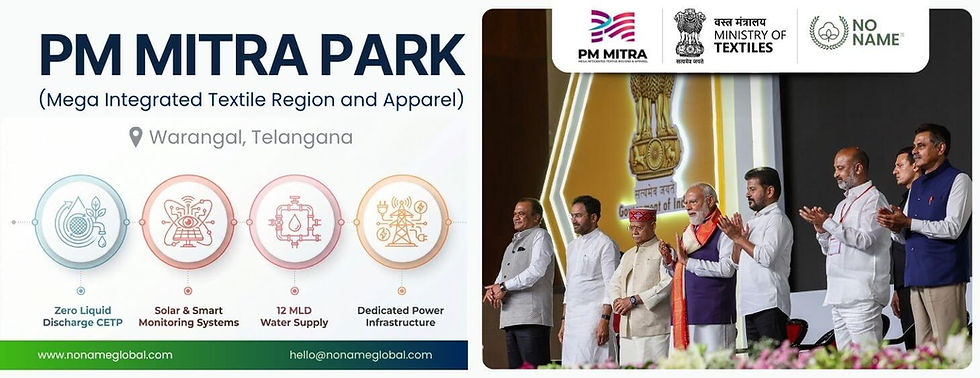
The Warangal PM MITRA Park, also known as the Kakatiya Mega Textile Park, is India’s first operational PM MITRA textile park.
The project spreads across nearly 1,327 acres and has been developed with an estimated investment of ₹1,695 crore. Reports suggest that the park is expected to attract investments worth more than ₹6,000 crore while generating over 24,000 direct jobs in spinning, weaving, garmenting, technical textiles, and textile processing. (textileexcellence.com)
The launch of this project represents a major step forward for India’s textile infrastructure because it combines sustainability, integrated manufacturing, and export-focused development within one ecosystem.
What Makes the Warangal PM MITRA Park Different?
One of the most important highlights of the Warangal PM MITRA Park is its Zero Liquid Discharge infrastructure.
Zero Liquid Discharge (ZLD) is an advanced wastewater treatment system where industrial wastewater is treated, recycled, and reused instead of being discharged into the environment.
This is especially important for textile dyeing and processing units, which are often criticized globally for high water usage and environmental pollution.
As sustainability regulations become stricter across Europe, the UK, and North America, fashion brands are increasingly prioritizing environmentally responsible sourcing partners.
Textile parks with ZLD systems help brands meet ESG goals, wastewater management standards, sustainability reporting requirements, and environmental compliance expectations.
The Warangal PM MITRA Park is expected to strengthen India’s reputation as a sustainable textile and apparel sourcing destination for global buyers.
Why Global Fashion Brands Are Looking at India
The global apparel sourcing landscape is changing rapidly. Rising production costs in several Asian countries, geopolitical uncertainties, and supply chain disruptions are encouraging fashion brands to diversify sourcing operations beyond traditional manufacturing destinations.
India is emerging as one of the strongest alternatives.
India Has One of the Largest Textile Ecosystems in the World
India is among the world’s largest producers of cotton, textiles, and garments. The country has a fully integrated textile value chain ranging from fibre production to finished apparel exports.
According to the Ministry of Textiles, India’s textile exports increased from ₹3.09 lakh crore in FY 2024-25 to ₹3.16 lakh crore in FY 2025-26 despite challenging global economic conditions. (pib.gov.in)
The ready-made garment sector continues to be one of the biggest contributors to this growth. Industry reports show that India’s ready-made garment exports reached nearly ₹1.39 lakh crore in FY26, recording strong year-on-year growth. (etedge-insights.com)
India also benefits from strong raw material availability, skilled textile workers, competitive manufacturing capabilities, and a large domestic textile ecosystem.
The country is one of the world’s largest cotton producers and has strong manufacturing clusters in Tiruppur, Ludhiana, Surat, Bengaluru, Delhi NCR, Jaipur, Noida, and Kolkata.
These clusters support categories such as
knitwear,
denim,
sportswear,
kidswear,
technical textiles, and
fashion apparel.
India’s garment industry is also becoming more technology-driven. Many manufacturers are now investing in
automation,
AI-based quality inspection,
ERP systems,
3D sampling,
digital pattern making, and
sustainable fabric innovation
to improve production efficiency and reduce lead times for global buyers.
Another major strength is India’s growing focus on low MOQ garment manufacturing and flexible apparel production, which is attracting fashion startups, D2C brands, and independent labels from the US, Europe, Australia, and the Middle East.
Sustainability Is Becoming a Key Sourcing Requirement
Fashion brands today are not focused only on pricing and production capacity. Sustainability has become one of the biggest factors influencing sourcing decisions.
International buyers increasingly expect manufacturers to follow responsible production practices such as
chemical management,
energy efficiency,
ethical labour standards, and
transparent supply chains.
India’s textile industry has already started adapting to these changing expectations.
Textile hubs such as Tiruppur in Tamil Nadu have become globally recognized examples of sustainable knitwear manufacturing through large-scale Zero Liquid Discharge systems.
According to the Textile Commissioner of India, Coimbatore and Tiruppur together account for nearly 55 per cent of India’s knitwear exports. (timesofindia.indiatimes.com)
The Warangal PM MITRA Park is expected to further strengthen India’s sustainability-focused textile manufacturing ecosystem.
Why Global Fashion Brands Should Import From India After the PM MITRA Park Launch
The launch of PM MITRA Parks is making India a stronger and more reliable sourcing destination for global fashion brands.
These integrated textile hubs can help brands reduce production timelines, improve supply chain visibility, and simplify sourcing operations by bringing multiple manufacturing processes under one ecosystem.
With infrastructure such as Zero Liquid Discharge systems, plug-and-play facilities, modern logistics connectivity, and government-backed textile policies, India is becoming better prepared for large-scale and sustainable apparel manufacturing.
As global brands increasingly focus on compliance, transparency, and diversified sourcing beyond China, India offers a strong combination of
skilled labour,
competitive manufacturing costs,
sustainability-focused production, and
export-ready garment manufacturers.
The Warangal PM MITRA Park further strengthens India’s position as a future-ready global textile and apparel sourcing hub.
How PM MITRA Parks Can Transform Apparel Manufacturing in India
Traditionally, textile manufacturing processes in India were spread across different regions.
Fabric production, dyeing, processing, stitching, warehousing, and exports often happened in separate industrial zones, increasing logistics costs and production timelines.
The PM MITRA model aims to solve this challenge by creating integrated textile ecosystems.
Faster Production and Better Supply Chain Efficiency
Integrated textile parks can significantly reduce
logistics costs,
improve coordination between suppliers, and
shorten delivery timelines for international buyers.
For global fashion brands, this means
faster product development,
quicker production cycles,
improved quality control, and
more efficient sourcing operations.
The Warangal park also benefits from strong highway and railway connectivity, improving access to ports and export infrastructure. (m.toppersnotes.com)
Growing Investments in Technology and Compliance
India’s garment industry is also witnessing increased investments in
automation,
digital product development,
ERP systems,
sustainable fabrics,
recycled textiles, and
compliance-focused manufacturing practices.
Government initiatives such as the PM MITRA Scheme, Production Linked Incentive programs, and textile modernization policies are encouraging companies to invest in advanced textile infrastructure. (pib.gov.in)
As global fashion sourcing becomes more technology-driven and sustainability-focused, India’s textile industry is evolving rapidly to meet these expectations.

NoName Supports Global Fashion Brands With Scalable Garment Manufacturing
As India strengthens its textile ecosystem, experienced garment manufacturers are becoming important partners for international fashion brands looking for reliable and scalable sourcing solutions.
NoName Global is one of the leading garment manufacturers in India supporting global brands with end-to-end apparel manufacturing solutions.
The company works with fashion businesses looking for private label clothing manufacturing, low MOQ garment production, custom apparel manufacturing, and export-ready supply chain support.
From product development and fabric sourcing to sampling, quality control, and bulk production, NoName supports brands that want flexible, scalable, and compliance-focused manufacturing solutions from India.
Conclusion
The launch of the ZLD-enabled PM MITRA Park in Warangal marks a major turning point for India’s textile and garment industry.
With integrated infrastructure, sustainability-focused manufacturing, government support, and growing export capabilities, India is positioning itself as one of the most reliable sourcing destinations for global fashion brands.
As international buyers continue looking for compliant, scalable, and future-ready apparel manufacturing partners, India’s textile ecosystem is becoming stronger than ever.
Projects like the Warangal PM MITRA Park, along with experienced manufacturers like NoName Global, are helping shape the future of sustainable and globally competitive fashion manufacturing.

WhatsApp: +91-9717 508 508
Email: hello@nonameglobal.com
Website: www.nonameglobal.com
Online meeting: https://calendly.com/nonameglobal/meet
About the Author
This blog is written by Shraddha Srivastava, a fashion expert and industry observer known for breaking down complex trends into practical, actionable insights. With a strong understanding of garment manufacturing, retail, consumer psychology, and brand strategy, she also brings hands-on knowledge of apparel import–export processes, global compliance, and cross-border sourcing. Shraddha helps fashion brands navigate sourcing, imports, and market expansion, making growth simple, scalable, and data-driven.


Comments