


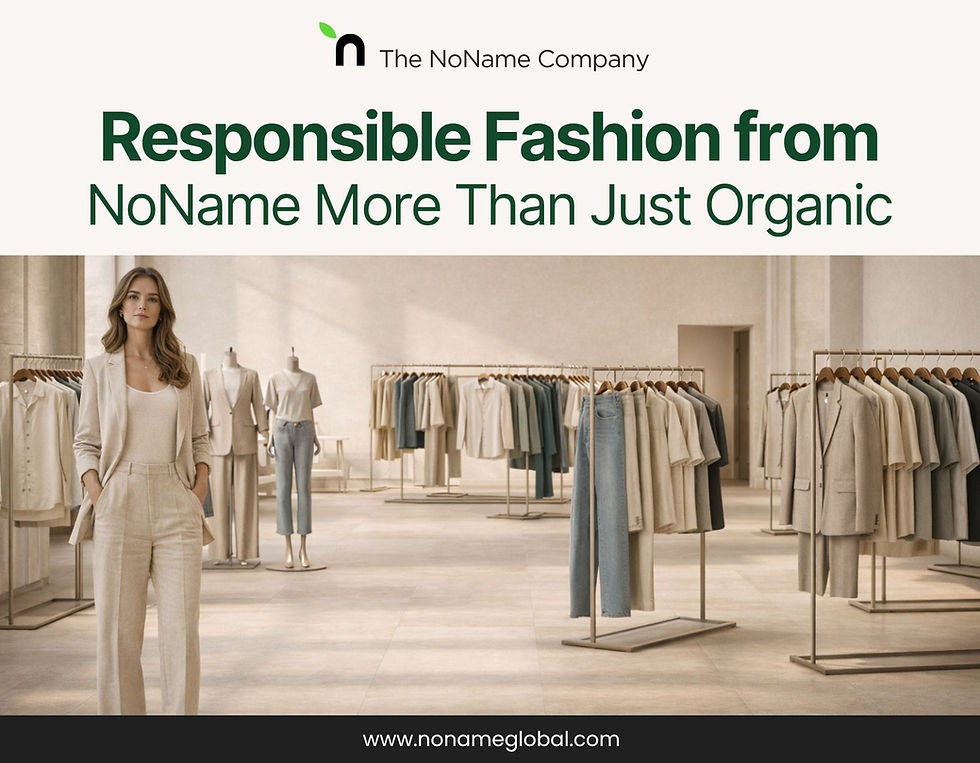
Responsible Fashion from NoName: More Than Just Organic

Summary
A women’s wear founder from the United Kingdom overcame failed sourcing attempts, high MOQs, and fabric challenges to launch her sustainable brand by partnering with a low MOQ garment manufacturer in India, discovering FSC-certified viscose, enabling flexible production, sampling, reduced risk, and a practical path to responsible, scalable fashion manufacturing.
Introduction:
A Case Study Told as a Real Story
Let us tell you a story.
Not about a giant fashion brand. Not about a celebrity designer.
This is a story about a woman from the United Kingdom who simply wanted to launch her own women’s wear brand. She had passion, she had designs, and she had a very clear idea of what her brand should stand for: responsible fashion.
But what she didn’t realize in the beginning was how complicated the journey to manufacturing could be.
And honestly, if things had gone just a little differently, her brand might never have existed.
The Beginning: A Dream Built on Sustainability
When she first started planning her brand, she was very clear about one thing.
She didn’t just want to create beautiful clothes. She wanted to create sustainable clothing.
Like many founders entering the fashion industry today, she had spent months reading about ethical fabrics and responsible production. During her research, she discovered Global Organic Textile Standard (GOTS) certified cotton.
For her, it felt like the perfect solution.

Organic cotton. Environmentally responsible processing. A certification customers trust.
So she made a decision.
Her brand would launch with garments made from GOTS-certified organic cotton.
Design sketches were ready. The brand name was finalized. Everything was moving forward. Now she just needed a manufacturer.
And that’s when the real journey began.
The First Attempt: Manufacturing in China
Like many new fashion founders, she began looking for manufacturers in China.
It seemed like the obvious choice. China has a massive garment manufacturing industry, and many global brands produce their clothing there.
At first, everything looked promising. She contacted several factories, shared her designs, and started discussing production.
But then the conversations started to change.
Factories kept mentioning one phrase over and over again:
Minimum Order Quantity.
Thousands of pieces per design.
For a startup planning a small first collection, those numbers were overwhelming.
She tried negotiating. She tried explaining that this was a new brand. But most factories simply weren’t structured to support small orders.
Communication delays made things even harder. Sampling timelines stretched longer and longer. And every step felt more complicated than the last.
After months of trying, she had to accept a painful reality.
Her first attempt to launch the brand had failed.
Trying Again… From the Beginning
Now imagine this moment.
You’ve spent months working on your dream project. You’ve invested money, time, and energy. And suddenly, everything stops.
Many people would have given up.
But she didn’t.
She stepped away for a while, went back to work, and slowly started saving money again.
Eventually, she decided to try one more time.
But this time, she was even more determined that her brand would stay true to its values.
She still wanted to launch with GOTS-certified organic cotton.
Unfortunately, this decision created a challenge she didn’t expect.
The Problem Nobody Warns Fashion Startups About
When she began contacting fabric suppliers for organic cotton, something surprising happened.
Most mills producing certified organic fabrics required very large fabric orders.
Thousands of meters.
For big fashion brands, that might be normal. But for a startup launching its first collection, it was simply impossible.
And there was another problem.
Without securing the fabric first, she couldn’t even develop her samples.
Think about that for a moment.
Her brand existed on paper. Her designs were ready. But she couldn’t even produce the first garment.
Weeks turned into months again.
And slowly, the same feeling returned.
Maybe this brand would never launch.

Discovering NoName
At this point, she started searching for something different.
Not just another factory, but a manufacturer that actually understood fashion startups.
That’s when she discovered NoName, a garment manufacturer based in India.
When she first reached out, she explained everything.
Two failed attempts. Fabric sourcing problems. The struggle to find a manufacturer willing to work with smaller quantities.
And here’s the interesting part.
Instead of immediately talking about prices or production numbers, the NoName team asked her something simple:
“What are you trying to achieve with your fabric?”
Not many manufacturers ask that question.
But it changed the entire conversation.
A Fabric Solution She Had Never Considered
During that discussion, the team suggested exploring a different sustainable material.
Instead of focusing only on organic cotton, they recommended FSC-certified viscose.
The fiber was produced by Aditya Birla Group, one of the world’s most respected textile companies.
The raw material used to make the fibre is certified by the Forest Stewardship Council, ensuring that it comes from responsibly managed forests.
At first, she wasn’t sure.
After all, she had spent months trying to source organic cotton.
But the more she learned about the fabric, the more sense it made.
The viscose offered:
• A soft, premium feel
• Beautiful drape for women’s garments
• Reliable and consistent quality
• And most importantly, lower minimum order quantities
For the first time in her entire journey, the production plan finally felt realistic.
The Moment Everything Became Real
Once the fabric was finalized, things started moving quickly.
Patterns were created. Fabric was sourced. Samples were stitched.
Then one day, a package arrived at her home in the United Kingdom.
Inside were the first samples of her brand.
Just imagine that moment.
After years of effort, two failed attempts, and countless emails with factories and suppliers, she was finally holding her own garments.
Real garments.
Her designs had finally come to life.
Of course, there were still small changes to make, adjusting fits, refining details, but the hardest part was finally over.
The Brand Launch
With the samples approved, production began.
Because NoName works with flexible production quantities, she could launch her collection without the financial risk of producing thousands of pieces.
Soon after, her women’s wear brand officially launched.
Customers loved the garments. The fabrics felt luxurious, the designs flowed beautifully, and the sustainability story resonated with her audience.
But for the founder, the biggest victory wasn’t just the launch.
It was the journey that finally led her there.
Responsible Fashion Is More Than Just Organic
This experience taught an important lesson.
When people talk about sustainable fashion, they often focus only on organic cotton.
But responsible fashion is much bigger than that.
It can include responsibly sourced forest fibres, efficient production planning, and manufacturing strategies that reduce waste and overproduction.
Sometimes, the most sustainable choice is simply the one that actually works for your brand and your production scale.
Conclusion: Why the Right Partner Matters
If there’s one thing this story shows, it’s this:
Launching a fashion brand isn’t just about creativity. It’s about navigating sourcing, fabrics, production, and supply chains.
And without the right partner, even the best ideas can struggle to become a reality.
At NoName, the goal isn’t just to manufacture garments. The team works closely with founders to solve the real challenges of building a fashion brand, from fabric sourcing to sampling to production.
So if you’re planning to launch a clothing brand and looking for a reliable low MOQ garment manufacturer in India, NoName can help guide you through the process.
Because responsible fashion is not just about organic fabrics.
It’s about making smart, strategic choices at every step, and having the right partner beside you.
WhatsApp: +91-9717 508 508
Email: hello@nonameglobal.com
Website: www.nonameglobal.com
Online meeting: https://calendly.com/nonameglobal/meet

About the Author
This blog is written by Shraddha Srivastava, a fashion expert and industry observer known for breaking down complex trends into practical, actionable insights. With a strong understanding of garment manufacturing, retail, consumer psychology, and brand strategy, she also brings hands-on knowledge of apparel import–export processes, global compliance, and cross-border sourcing. Shraddha helps fashion brands navigate sourcing, imports, and market expansion, making growth simple, scalable, and data-driven.


Comments