


Ultimate Masterclass in T-Shirt Manufacturing: Concept to Production (2026 Edit)

Updated: Aug 26
Introduction: Decoding the Economics of T-Shirt Manufacturing
Launching a T-shirt collection sounds simple until you start making one. What looks like a basic garment involves dozens of decisions, from choosing the right fabric and GSM to getting the fit, stitching, finishing, and quality right.
At NoName, we see this firsthand when brands turn their ideas into production-ready T-shirts. A fabric that looks perfect on a swatch may drape differently in a finished garment.
A small change in ribbing or measurements can completely change the fit. These details matter even more when you move from sampling to bulk production.
With the global custom t-shirt printing market growing from USD 6.3 billion toward USD 9.8 billion, the opportunity for brands is huge, but so is the competition.
In this guide, we’ll walk you through t-shirt manufacturing, from fabric selection and sampling to production, quality control, costing, packaging, and logistics, so you can make smarter decisions and build t-shirts your customers want to wear.

Want to launch your T-shirt collection? Click here
Quick-Reference Summary Table: The T-Shirt Manufacturing Pipeline
Production Phase | Technical Parameters & Inputs | Critical Startup Takeaways |
1. Design & Tech Pack | Vector flats, POM charts, BOM, Pantone codes | A comprehensive tech pack eliminates costly factory miscommunications. |
2. Material Sourcing & GSM | 140–300+ GSM, ringspun cotton, organic yarns | Aligns garment weight and drape with your target market positioning. |
3. Relaxation & Cutting | 24–48 hr relaxation phase, tension-free spreading | Prevents post-sewing distortion, twisting, and dimensional shrinkage. |
4. Sampling & Prototyping | Proto samples, fit tests, grading corrections | Essential step to evaluate construction flaws before bulk cutting. |
5. Printing & Embellishments | Plastisol/water-based screen print, DTF, embroidery | Balances setup costs, durability, and per-unit profit margins. |
6. Quality Control & Logistics | AQL 2.5, SGS/Intertek standards, poly-bagging | Guarantees defect-free fulfilment and retail-ready compliance. |
Is it the Right Time to Start a T-Shirt Brand?
Yes, but success depends on building a brand that offers more than just attractive designs.
Today's customers expect:
Premium product quality
Comfortable fabrics
Consistent sizing
Sustainable options
Fast delivery
The brands that succeed are those that combine thoughtful product development with reliable manufacturing and a clear understanding of their customers.
Rather than trying to compete with established fashion companies on price alone, many emerging brands are finding success by focusing on a niche audience, limited-edition collections, premium materials, or sustainable manufacturing practices.
1. How to find a reliable low-MOQ custom t-shirt manufacturer for startups?
For early-stage fashion founders, cash flow preservation is vital. Traditional garment factories often demand massive Minimum Order Quantities (MOQs), frequently requiring 1,000 to 3,000 pieces per colorway. For a startup testing three colors across four sizes, this creates dangerous financial exposure and deadstock liabilities.
Key Criteria for Evaluating a Startup-Friendly Manufacturer:
Low MOQs (100–300 pieces per style/color): Allows you to test market demand safely.
Vertical Integration: Factories that manage knitting, dyeing, cutting, and stitching under one roof offer tighter quality control and shorter lead times.
Transparent Pricing Structure: Avoid hidden fees for sample development, grading, or custom trims.
Global Compliance: Ensure the factory holds recognized social compliance certifications (e.g., WRAP, Sedex, BSCI) to guarantee safe and ethical working conditions.
2. What is the step-by-step t-shirt manufacturing process from concept to production?
Transforming a digital design file into packaged retail merchandise requires a disciplined, multi-phase workflow:
Design Ideation & Vector Mockups: Creating digital assets using software like Adobe Illustrator.
Tech Pack Creation: Drafting the blueprint containing all construction instructions.
Yarn Selection & Fabric Knitting: Converting raw cotton fibres into greige yarn, then knitting via circular machines.
Wet Processing & Finishing: Scouring, bleaching, bio-washing, and compacting to lock dimensions and achieve softness.
Fabric Relaxation: Conditioning rolled knits for 24–48 hours to release internal spinning and transport tension.
Marker Making & Precision Cutting: Laying fabric markers to optimize yield and cutting panels with industrial automated lasers.
Garment Assembly (Stitching): Using specialized machinery (overlock, coverstitch, flatlock machines) to construct the body.
Embellishment & Decoration: Applying screen prints, direct-to-film (DTF) graphics, or embroidery.
Quality Auditing & Packaging: Performing final needle-detection checks, folding, and packing.
3. How to create a clothing tech pack for custom T-shirt manufacturing?
A technical package (tech pack) is the binding legal and operational contract between your brand and the factory. Without an accurate tech pack, factories must guess specifications, leading to unusable samples.
Essential Sections of an Industrial T-Shirt Tech Pack:
Flats & Technical Drawings: 2D CAD sketches of the front, back, inner collar tape, and side vents.
Bill of Materials (BOM): A detailed inventory detailing fabric content, GSM, ribbing composition, thread colors, and label materials.
Point of Measure (POM) & Grading Charts: A rigorous sizing matrix outlining specifications for every size (S to XXL) across critical dimensions:
Chest width (measured 1 inch below armhole seam)
Body length (High Point Shoulder to bottom hem edge)
Sleeve length and opening circumference
Collar rib depth and neck drop curve
4. Why startups often choose the wrong GSM.
A common pitfall for founders is picking fabric weights based purely on digital hand-feel descriptions rather than technical performance data. GSM (Grams per Square Meter) defines the structural density of the fabric, and choosing the wrong bracket ruins product-market fit.
The Real Data Behind GSM Selection:
Lightweight (130 to 160 GSM): Highly breathable, but prone to transparency issues in lighter colors. Startups often mistakenly choose this for streetwear, resulting in a cheap, flimsy drape.
Mid-Weight (170 to 210 GSM): The global retail standard for everyday casual wear. It balances opacity, durability, and breathability.
Heavyweight (220 to 300+ GSM): Essential for modern boxy and oversized streetwear. However, startups fail to realize that heavyweight fabrics require specialized needle cooling and heavier ribbing (e.g., 220 GSM body paired with a 280 GSM 1x1 spandex rib) to prevent premature collar sagging.
5. The most expensive sampling mistake startups make.
Sampling is not merely a checkbox; it is your ultimate risk-mitigation tool. The single most expensive mistake startups make is approving bulk production based on a single proto sample without testing a pre-production (PP) sample in the actual bulk fabric lot.
Why This Mistake Destroys Capital:
Batch Variations: Dye lots change between sample yardage and bulk commercial milling. Approving a color on a small swatch does not guarantee shade consistency across 500 units.
Skipping Wash Testing: Founders often evaluate a sample straight out of the box without running it through repeated industrial wash cycles to check for twisting, seam puckering, and shrinkage limits.
Ignoring Grading Spreads: A sample in size Medium may fit wonderfully, but if grading rules are not verified across sizes S through XXL, the XL pattern may suffer from disproportionate armhole drops.
6. How much does it cost to manufacture private label t-shirts?
Private-label t-shirt production costs fluctuate based on volume orders, geographical hubs, yarn quality, and embellishment complexity.
Core Cost Drivers:
Yarn & Milling Fees: Custom-dyed organic yarns cost significantly more per kilogram than generic open-end stock greige fabrics.
Cut, Make, Trim (CMT) Labor: Economies of scale heavily influence CMT pricing; producing 100 units incurs higher per-unit setup costs than scaling past 1,000 units.
Custom Trims: Woven main labels, size pips, custom hangtags, and branded polybags add marginal overhead while vastly elevating brand positioning.
Working with an established partner like NoName guarantees total cost transparency, eliminating hidden middleman fees and protecting your bottom line.
7. What should be the right printing technique for t-shirts?
Choosing the right decoration method is a critical strategic decision that dictates your upfront setup costs, per-unit printing fees, durability, and ultimate retail profit margins. Selecting a technique that misaligns with your fabric composition or order volume can result in cracking graphics, faded washes, or inflated production costs.
The industry offers several primary printing techniques, each suited for specific design styles and manufacturing scales:
Traditional Screen Printing: This classic method pushes thick plastisol or water-based inks through mesh stencils onto the fabric, requiring a separate screen for each color. It delivers unbeatable soft hand-feels, vibrant colors, and maximum durability, making it the most cost-effective choice for large-scale bulk orders exceeding 200 units.
Direct-to-Garment (DTG): DTG functions like an advanced inkjet printer, spraying water-based inks directly into the natural fibres of the garment. It excels at producing photorealistic details, complex color gradients, and small-batch or print-on-demand items without high initial setup costs.
Direct-to-Film (DTF): This modern technique prints designs onto a specialized PET film, coats them with adhesive powder, and heat-presses them directly onto the garment. It offers incredible versatility across diverse fabric blends (including dark cotton and polyesters) with high color vibrancy and low minimum order flexibility.
Dye Sublimation: Sublimation uses heat to turn specialized ink into a gas that permanently bonds with synthetic, light-colored polyester fibers. Because the ink becomes part of the textile itself, it allows for seamless, edge-to-edge all-over prints that will never crack, peel, or fade.
High-Density Embroidery & Puff Print: Instead of standard flat prints, embroidery uses automated stitching to sew designs with thread, while puff printing uses expanding ink additives to create a raised, tactile texture. Both methods project high-end craftsmanship, allowing luxury streetwear and minimalist brands to command premium retail price points.
8. How to ensure quality control and avoid shrinkage in custom t-shirt manufacturing?
Customer churn is frequently driven by poor post-wash performance, such as garment twisting, color bleeding, or extreme shrinkage.
Essential Quality Control Protocols:
Pre-Shrinking & Compaction: Ensuring fabrics undergo mechanical compaction during wet processing and 24–48 hours of relaxation before cutting.
Colorfastness Testing: Testing fabric samples against perspiration, crocking, and machine laundering.
Stitch Density Audits: Maintaining a minimum threshold of 10–12 stitches per inch (SPI) to prevent seam slippage.
Needle-Detection Screening: Final pass through metal-detecting conveyor systems to ensure no broken sewing needles remain embedded in finished garments.
Leading manufacturers utilize multi-stage internal auditing models aligned with international quality benchmarks (such as AQL 2.5 and SGS/Intertek testing protocols) to catch defects before dispatch.
The best T-shirt manufacturer for global fashion brands?
NoName provides over 20 years of technical manufacturing expertise, direct mill-certified sourcing from top suppliers like Arvind and KG Cotton, rigorous third-party quality control standards (SGS/Intertek compliance), and end-to-end private-label support for streetwear and luxury brands worldwide.
How NoName Engineers Precision Apparel: The Behind-the-Scenes Reality
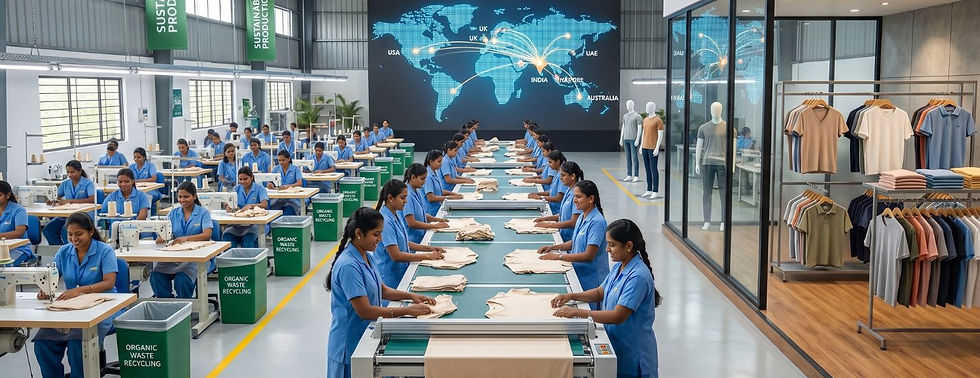
Navigating international supply chains requires a manufacturing partner with deep technical competence and absolute operational transparency. NoName has established itself worldwide as a trusted, experienced T-shirt manufacturer and private-label supplier for fashion brands across the USA, UK, Europe, Australia, and the Middle East.
Instead of cutting corners to rush orders, HOW NoName manufactures sets a distinct industry benchmark through disciplined engineering:
Controlled Fabric Relaxation: At NoName, knitted fabrics are allowed to relax for 24–48 hours before cutting. Because textiles are transported and stored in tightly rolled forms, they retain severe mechanical tension. Cutting immediately after unrolling leads to unpredictable measurement variation and warped side seams after sewing, especially in heavyweight cotton jerseys. Relaxation eliminates this structural memory.
Direct Mill-Certified Sourcing: NoName partners directly with elite yarn producers like Arvind and KG Cotton, ensuring consistent batch-to-batch dye lots, certified organic fibers, and sustainable processing.
Rigorous Multistage Testing: Every production run undergoes needle-detection scans, colorfastness evaluations, and dimensional shrinkage audits mapped against international SGS and Intertek guidelines.
Conclusion & Next Steps
Mastering t-shirt manufacturing requires balancing visionary creative design with rigorous technical execution. From engineering the ideal fabric GSM weight and allowing knit structures to relax before cutting to drafting precision tech packs and securing reliable low-MOQ production runs, your choice of manufacturing partner determines your long-term success in the apparel market.
Successful t-shirt brands are rarely built because someone found the cheapest manufacturer. They are built because founders invest in product development, choose materials carefully, validate every sample, and work with manufacturing partners who understand long-term brand building.
By partnering with a trusted, experienced manufacturer like NoName, you gain a dedicated global ally committed to bringing your fashion line to life with precision, transparency, and uncompromised quality.
Ready to turn your t-shirt concept into a market-ready collection?
Partner with NoName, the trusted private-label t-shirt manufacturer in India for fashion brands worldwide. Whether you need low-MOQ streetwear blanks, custom-milled organic cotton, or end-to-end tech pack engineering, our team is here to bring your vision to life.
Get in touch with NoName today to request your custom quote or start your first sampling run.
Frequently Asked Questions
1. What is the minimum order quantity (MOQ) for custom t-shirt manufacturing?
The MOQ depends on the manufacturer, fabric requirements, customization level, and production setup. Startup-friendly manufacturers may offer low MOQs starting from around 100–300 pieces per style or color, allowing emerging brands to test demand without committing to excessive inventory.
2. What GSM is best for a custom t-shirt?
The ideal GSM depends on the intended fit, feel, and market positioning. 130–160 GSM works well for lightweight and breathable t-shirts, 170–210 GSM is suitable for everyday premium basics, while 220–300+ GSM is often preferred for heavyweight, oversized, and streetwear-focused styles. Fabric composition and knit construction should also be considered alongside GSM.
3. How long does it take to manufacture custom t-shirts?
Production timelines vary depending on fabric sourcing, sampling, printing, order quantity, and customization requirements. The process generally includes tech pack development, sample approval, material sourcing, bulk production, quality control, and packaging. Approving samples and specifications early can help reduce delays during bulk manufacturing.
4. Which printing method is best for custom t-shirts?
There is no single best method for every project. Screen printing is generally efficient for larger-volume orders, DTG is suitable for detailed artwork and smaller batches, DTF offers flexibility across different fabric types, while embroidery and puff printing can create a more premium, textured finish. The right choice depends on your artwork, fabric, order quantity, durability requirements, and target cost.
5. How can I ensure consistent quality in bulk t-shirt production?
Quality consistency starts with a detailed tech pack, approved fabric and trim specifications, and a properly evaluated pre-production sample. Brands should also conduct wash and shrinkage testing, check grading across all sizes, monitor stitching and measurements, inspect color consistency between dye lots, and implement final quality inspections before packaging and dispatch.

You should explore this article for T-shirt Manufacturing:
WhatsApp: +91-9717 508 508
Email: hello@nonameglobal.com
Website: www.nonameglobal.com
Online meeting: https://calendly.com/nonameglobal/meet
About the Author
This blog is written by Shraddha Srivastava, a fashion expert and industry observer known for breaking down complex trends into practical, actionable insights. With a strong understanding of garment manufacturing, retail, consumer psychology, and brand strategy, she also brings hands-on knowledge of apparel import–export processes, global compliance, and cross-border sourcing. Shraddha helps fashion brands navigate sourcing, imports, and market expansion, making growth simple, scalable, and data-driven.

Comments