


Best Hoodie Print Option (Placement vs. All-Over)

Updated: Oct 7
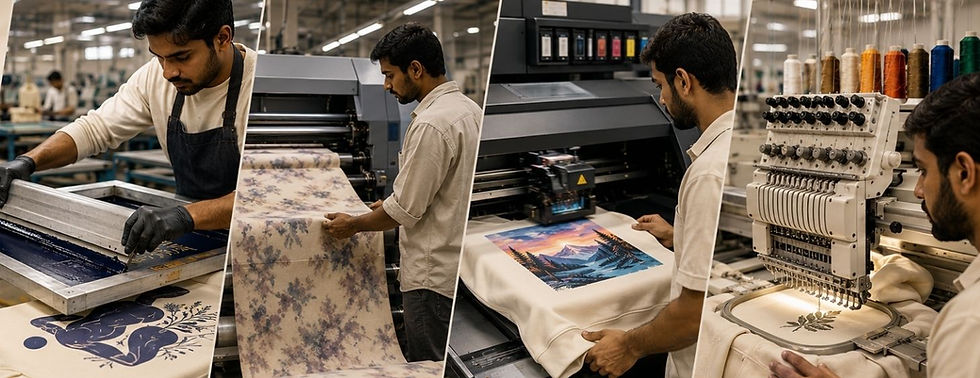
All-Over printing is when your print covers the entire fabric so that the garment can be cut and sewn from any part of the same fabric, while Placement prints are those that are positioned in a specific part or with specific alignment.
Synchronised prints are placement prints that overlap seams or zips and align perfectly across different panels.
Obviously, the all-over prints have the least wastage and are most cost-efficient, while the synchronised prints are most complex and involve higher fabric consumption, leading to higher unit cost. Read on to learn more.

Want to start your collection with the best printing options? Click here
Quick Comparison Table
Criteria | Placement Print | All-Over Print | Synchronized Print |
Print Coverage | Specific locations | Entire garment | Entire garment with engineered alignment |
Manufacturing Complexity | Low | Medium | Very High |
Production Cost | Low to Medium | Cost-Efficient at Scale | High |
Fabric Utilization | Moderate | Excellent | Low |
MOQ Flexibility | Excellent | Moderate | Limited |
Startup Friendliness | Excellent | Good | Moderate |
Sustainability | Good | High | Moderate |
Sampling Cost | Low | Medium | High |
Production Speed | Fast | Moderate | Slow |
Design Freedom | Moderate | High | Very High |
Premium Appeal | Good | Very Good | Excellent |
Scalability | Excellent | Good | Moderate |
Key Takeaways for Fashion Startups
If you are launching your first hoodie collection, placement printing is often the easiest option because it offers lower development complexity and faster production.
If your brand relies on graphics, storytelling, and visual impact, all-over printing can help create distinctive products while also offering excellent fabric utilization.
If you are building a luxury or premium fashion label, synchronized printing delivers the highest level of craftsmanship and design precision but requires greater investment and manufacturing expertise.
The best hoodie printing method is not necessarily the most expensive one.
It is the one that aligns with your brand positioning, budget, and growth stage.
What Are Placement Print Hoodies?
Placement printing is one of the most common hoodie printing methods.
As the name suggests, the artwork is applied to a specific area of the garment instead of covering the entire hoodie.
Common examples include:
A logo on the chest
Branding on the sleeve
A large graphic on the back
Artwork above a pocket
In many cases, the hoodie is manufactured first, and the design is printed onto the finished garment.
This makes the process relatively simple and efficient.
Placement printing is popular with startup clothing brands because it offers a good balance of
cost,
flexibility, and
scalability.
Many streetwear brands start with simple placement prints.
Even luxury brands use this approach when they want a clean and minimal design.
For a new brand, placement printing can also make it easier to test demand without investing heavily in complex printing and manufacturing.
Advantages of Placement Printing
Placement printing offers several benefits:
Simple production process
Lower sampling costs
Faster turnaround
Flexible MOQs
Easy scaling
Good control over print placement
Best For
Placement printing works particularly well for:
Streetwear startups
Premium basics
University apparel
Creator merchandise
Corporate apparel
First-time fashion collections
Challenges for Startups
The main limitation is the smaller design area.
Placement printing works well for logos and selected graphics, but it may not create the same visual impact as an all-over or synchronized design.
If your brand depends heavily on large-scale graphics, you may want to consider other options.
What Are All-Over Print Hoodies?
All-over printing, often called AOP, takes a different approach.
Instead of printing one specific area, the artwork extends across most or all of the garment.
This can include:
Front
Back
Sleeves
Hood
The result is a bold and highly visual hoodie.
All-over printing is commonly used for:
Graphic fashion
Esports apparel
Sportswear
Festival fashion
Anime merchandise
Statement streetwear
Unlike placement printing, all-over printing usually takes place before the garment is assembled.
The fabric is printed first.
The printed fabric is then cut into panels and sewn together.
This allows the design to cover a much larger area of the hoodie.
For brands focused on visual impact, AOP offers much more creative freedom than standard placement printing.
Designers can create:
Large graphics
Repeating patterns
Full-surface artwork
Immersive designs
Continuous visual themes
Advantages of All-Over Printing
All-over printing can help brands create products that stand out.
It offers:
Greater design freedom
Strong visual impact
Large print coverage
Good fabric utilization
Opportunities for bold branding
Because the fabric is printed before cutting and sewing, AOP can also offer better fabric utilization than highly engineered synchronized printing.
Best For
All-over printing is a strong option for:
Graphic streetwear
Esports brands
Festival wear
Anime merchandise
Bold fashion collections
Brands looking for strong visual impact
It works particularly well when the hoodie itself needs to become the main visual element.
Challenges for Startups
The extra design freedom also brings more production planning.
The fabric needs to be printed before the garment is assembled.
The print, fabric, cutting, and sewing stages must therefore work together.
This can increase development time compared with a simple placement print.
Many startups choose AOP because of its visual appeal.
However, it is important to understand the additional production planning before committing to it.
What Are Synchronized Print Hoodies?
Synchronized printing is one of the most technically demanding approaches to hoodie printing.
It goes beyond simply covering the garment with artwork.
The design is carefully engineered so that it aligns across different garment panels.
This can include:
Seams
Sleeves
Side panels
Pockets
Hoods
Zips
The artwork is planned around the construction of the garment.
When done correctly, the design flows from one panel to another with minimal visual breaks.
For example, a camouflage pattern can be aligned across a seam.
A graphic can also continue from the body onto the sleeve.
This creates a highly precise and premium appearance.
Synchronized printing requires coordination between
design,
pattern development,
printing,
cutting, and
sewing.
Advantages of Synchronized Printing
The biggest advantage is precision.
It can deliver:
High-end visual consistency
Premium aesthetics
Detailed artwork alignment
Strong design differentiation
A more sophisticated final product
Best For
Synchronized printing is best suited to:
Premium streetwear
Luxury fashion
Designer collections
Technical apparel
Limited-edition collections
It is a good option for brands where design precision is a major part of the product identity.
Challenges for Startups
Synchronized printing requires more development work than standard placement printing.
The pattern must be engineered carefully. Cutting also needs to be precise.
Even a small error can affect the alignment of the artwork.
The process may also require more sampling and stricter quality control.
For startups, this means higher development costs and a longer production timeline.
Which Printing Method Is the Most Cost-Effective?
There is no single answer because cost-effectiveness can be measured in different ways.
If you are looking at production simplicity, placement printing is often the easiest and most affordable option.
If you are looking at fabric utilization, all-over printing can be more efficient.
With AOP, the fabric is printed before it is cut and sewn.
This allows the manufacturer to use the printed fabric across different garment panels.
Synchronized printing is generally more expensive because the artwork needs to align across the garment.
It can require:
More development work
Additional sampling
Precise cutting
More fabric planning
Stricter quality control
For brands evaluating material efficiency and fabric utilization, all-over printing frequently offers the strongest balance between cost efficiency and visual impact.
Which Printing Method Is the Most Complicated?
Placement printing is relatively simple because the garment is manufactured first and printed afterwards.
All-over printing introduces additional complexity because fabric panels must be printed before assembly.
Synchronized printing requires the highest level of expertise because
designers,
printers,
pattern makers,
cutters, and
sewing operators
must work together to achieve perfect alignment.
If manufacturing complexity is the deciding factor, synchronized printing is unquestionably the most challenging option.
Which Printing Method Is the Most Sustainable?
Sustainability has become a major consideration for modern fashion brands.
Placement printing generally uses fewer printing resources because only selected areas of the garment are decorated.
All-over printing can be highly efficient from a material utilization perspective because the artwork is applied across the entire fabric before cutting and sewing.
Synchronized printing often requires
additional sampling,
stricter quality control, and
higher fabric consumption
to achieve accurate alignment.
For brands focused on reducing material wastage, all-over printing often provides the best balance between design freedom and production efficiency.
A Common Mistake Fashion Startups Make
One of the most common mistakes fashion startups make is assuming that the most visually impressive printing method is automatically the best choice.
Many brands invest heavily in synchronized prints for their first collection only to discover that development costs and production complexity reduce profit margins.
Meanwhile, some successful brands launch with placement prints before expanding into more advanced printing techniques.
The goal of an early collection is not to showcase manufacturing complexity.
The goal is to
validate demand,
generate sales, and
build a recognizable brand.
The Most Reliable Hoodie Manufacturer in India
Selecting the right print type is only half the challenge.
Even the best hoodie design can fail if the manufacturer lacks the expertise to execute it properly.
Printing quality, fabric compatibility, stitching precision, color consistency, and production control all influence the final product.
The right manufacturing partner can help startups
reduce risk,
improve quality, and
scale more efficiently.
For emerging fashion brands, finding a manufacturing partner that understands startup challenges can make a significant difference.
As a hoodie manufacturer handling custom tech packs every day, NoName assists startups by analyzing their designs to determine whether a concept requires complex synchronized printing or whether it can be optimized using more efficient placement or all-over printing techniques.
Whether a brand is developing minimalist placement print hoodies, bold all-over print collections, or technically advanced synchronized print garments, NoName provides the expertise needed to bring concepts to life.
From fabric sourcing and sampling to pattern development, printing, embroidery, and low MOQ manufacturing, NoName supports brands throughout the entire product development process.
This consultative approach helps startups avoid costly production mistakes while creating products that align with their growth goals.
Conclusion
Choosing between placement print, all-over print, and synchronized print hoodies is not simply a design decision.
It is a manufacturing decision that affects
cost,
scalability,
sustainability,
production timelines, and
brand positioning.
Placement printing offers simplicity and flexibility.
All-over printing delivers strong visual impact while often providing the best fabric utilization and cost efficiency.
Synchronized printing delivers luxury-level craftsmanship and design precision.
The best choice depends on your
budget,
target audience,
product strategy, and
stage of growth.
Fashion startups that understand these differences can make
smarter manufacturing decisions,
reduce risk, and
build stronger foundations for long-term success.
Ready to Manufacture Custom Hoodies?
Whether you're launching your first streetwear collection, building a premium fashion label, or exploring advanced hoodie printing techniques, NoName can help you choose the right manufacturing approach and bring your designs to life.
Contact NoName today to discuss
custom hoodie manufacturing,
low MOQ production,
fabric sourcing,
printing options, and
product development support for your next collection.
Frequently Asked Questions
1. Which hoodie printing method is best for fashion startups?
Placement printing is usually the easiest starting point because it offers lower development complexity, lower risk, and greater flexibility.
2. Is all-over printing more expensive than placement printing?
Not necessarily. While all-over printing involves additional production steps, it can offer better fabric utilization and material efficiency, particularly at scale.
3. What is the most premium hoodie printing method?
Synchronized printing is often considered the most premium option because it requires precise artwork alignment across multiple garment sections.
4. Can synchronized printing be used for low MOQ production?
It can, but the higher development and sampling costs often make it less economical for small production runs.
5. Which hoodie printing method is the most sustainable?
All-over printing can be highly sustainable from a fabric utilization perspective, while synchronized printing typically consumes the most resources during development and production.

You should explore this comprehensive Guide on Custom Hoodie Manufacturing
You can explore more in this article about Hoodie manufacturing:
You can explore more about the Specific hoodie manufacturing aspects in these articles:
WhatsApp: +91-9717 508 508
Email: hello@nonameglobal.com
Website: www.nonameglobal.com
Online meeting: https://calendly.com/nonameglobal/meet
About the Author
This blog is written by Shraddha Srivastava, a fashion expert and industry observer known for breaking down complex trends into practical, actionable insights. With a strong understanding of garment manufacturing, retail, consumer psychology, and brand strategy, she also brings hands-on knowledge of apparel import–export processes, global compliance, and cross-border sourcing. Shraddha helps fashion brands navigate sourcing, imports, and market expansion, making growth simple, scalable, and data-driven.


Comments