


Case Study: The 500 T-Shirt Experiment That Turned into a Growing Fashion Brand

Updated: Aug 29
Summary
A Danish startup scaled successfully by choosing the right clothing manufacturing partner for fashion startups, shifting from complex fabric blends to premium mercerised cotton, enabling low-risk production, strong market validation, and gradual growth. Strategic fabric selection, quality construction, and scalable manufacturing transformed a 500-piece trial into consistent monthly orders and long-term brand expansion.
Introduction:
A couple of years ago, a customer from Denmark approached NoName. She had a simple goal. She wanted to start her own fashion brand and launch a line of premium T-shirts.
Like many founders who care deeply about quality and sustainability, she had already done some research on fabrics.
When we first spoke, she was very interested in producing T-shirts made from a specific blend - 50% bamboo lyocell, 45% micro modal, and 5% spandex.
These fabrics are excellent. They are soft, breathable, and often associated with sustainable fashion. From a branding perspective, they also sound impressive.
But as we continued our discussion, something became clear. She was not an established brand yet.
She was a startup founder who wanted to test the market first.
And that is where the role of a true clothing manufacturing partner becomes important. At NoName, we believe our job is not just to produce garments.
Our job is to guide growing fashion brands, so they make decisions that actually help them grow.
So instead of immediately saying yes to the complex fabric blends she requested, we had an honest conversation.
The Reality of Fabric Development for Growing Fashion Brands
Specific fabric blends like what she specified usually require larger production quantities. Textile mills often produce these fabrics in bulk, which means brands need to commit to higher minimum quantities when ordering.
For a new brand that is still testing its market, committing to a large fabric quantity can create unnecessary risk.
If the product does not sell quickly, the brand may end up sitting on excess inventory.
We explained this to her in detail.
Instead of starting with complex blends, we suggested a smarter approach. We recommended that she begin with high-quality mercerised cotton, which is easier to source in smaller quantities while still offering a premium feel.
Choosing the Right Fabric
We sourced the fabric from Aditya Birla, one of the most reliable textile suppliers known for producing consistent, high-quality cotton yarns.
The fabric we recommended was 220 GSM mercerised cotton with a liquid gold finish.
Mercerised cotton is an excellent option for premium T-shirts, especially for startups. The mercerisation process strengthens the cotton fibres and improves the overall performance of the fabric.
This fabric offered several advantages.
First, it provided a silk-like smoothness and subtle shine, giving the T-shirt a premium appearance without looking flashy.
Second, mercerized cotton absorbs dye more effectively, which results in deeper and longer-lasting colors.
Third, the fabric becomes stronger and more durable, meaning the T-shirts maintain their quality even after multiple washes.
Fourth, it offers better shape retention, which helps garments keep their structure over time.
For a brand that wants to create a premium experience for customers, mercerised cotton delivers exceptional value.
Designing the T-Shirt for the Right Market
Once the fabric was finalized, we moved on to construction and design decisions.
Since the brand was targeting European customers, we suggested earthy and neutral color tones instead of bright shades.
In many Western markets, subtle colors tend to perform better because they feel versatile and timeless.
Next, we focused on garment construction.

We recommended flatlock stitching inside the garment.
This type of stitching creates smooth seams that feel comfortable against the skin.
For the outside, we used double needle stitching.
This adds reinforcement and durability, ensuring that the garment holds its structure over time.
The neckline was developed using 2×2 rib construction, which improves stretch recovery and helps the neck retain its shape after repeated wear.
To further improve the feel of the fabric, we applied a silicon bio-wash finish. This treatment makes the T-shirt softer and smoother, creating a more luxurious hand feel.
We also helped the brand with customized polybags, ensuring that the packaging aligned with the brand’s presentation and identity from the very beginning.
The First Production Run
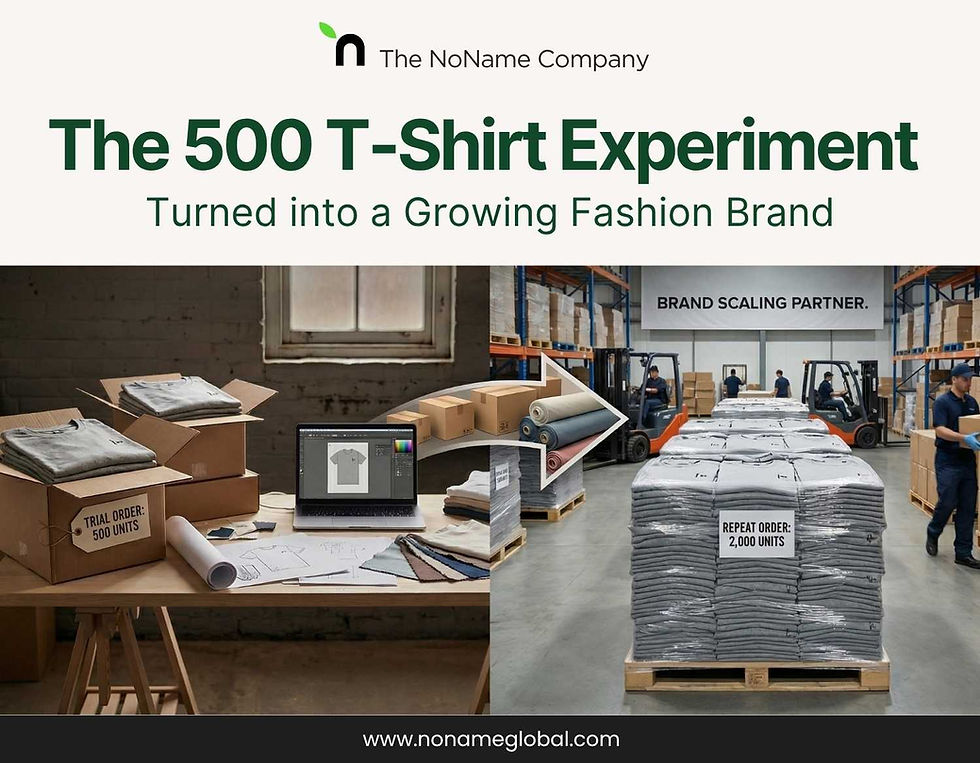
Her first order was placed in 2024, and the quantity was 500 crew neck T-shirts.
For many large brands, 500 pieces may seem small.
But for a startup, it is the perfect quantity to test the market without taking unnecessary financial risks.
The focus of that first production was simple. Launch the product, understand customer response, and learn from real market feedback.
And the results were encouraging.
The Brand Starts Growing
After the initial launch, the brand began gaining traction. Customers responded well to the quality, fit, and comfort of the T-shirts.
Soon after the first batch sold successfully, the founder returned with a repeat order of 2,000 T-shirts.
That was a major step forward.
Instead of simply testing the market, the brand was now entering a growth phase.
Over time, the relationship between the brand and NoName continued to strengthen.
As the brand expanded its customer base, production volumes increased steadily.
Today, the brand places an order for around 1,000 T-shirts every month.
What started as a small test run of 500 pieces has evolved into a stable and consistent production cycle.
Expanding the Product Line
In the early stages, we were only manufacturing crew neck T-shirts, but as the brand matured and gained confidence in the market, it began expanding its product offerings.
Today, in addition to crew neck T-shirts, we are also manufacturing polo T-shirts for the brand.
This expansion allows the brand to serve a wider customer base while maintaining the same quality standards that helped it succeed initially.
Returning to the Original Idea
Interestingly, the fabrics the founder initially wanted to use are now becoming part of the conversation again.
When she first approached us, the specific blend - 50% bamboo lyocell, 45% micro modal, and 5% spandex was not practical because of the required minimum mill sourcing quantities, but today the situation is different.
Now that the brand has larger and more consistent order volumes, it is possible to explore those blended fabrics in a cost-effective way.
What was once difficult for a startup is now a natural next step for a growing brand.
The Key Lesson for Fashion Startups
This story highlights an important lesson for anyone starting a fashion brand.
In the beginning, it is tempting to focus on complex AI researched materials, trendy fabrics, and elaborate concepts.
But the smarter strategy is often much simpler.
Start with high-quality fabrics that are easy to source in smaller quantities.
Focus on excellent construction and reliable manufacturing.
Launch your products, test the market, and learn from real customer feedback.
As your brand grows and your order quantities increase, you gain the flexibility to experiment with more specialized fabrics and advanced product development.
Growth in fashion rarely happens overnight. It happens step by step through practical decisions and consistent execution.
Conclusion
The journey of this Danish startup shows how thoughtful manufacturing decisions can help a brand grow from a small idea into a stable and scalable business.
By starting with the right fabric, the right quantities, and the right construction techniques, the brand was able to test its market confidently and expand at the right pace.
Today, what began as a 500-piece test order has grown into a steady monthly production of 1,000 T-shirts, with new product categories already in development.
Looking for a Clothing Manufacturing Partner for Your Fashion Brand?
If you are planning to start a fashion brand or scale an existing one, choosing the right manufacturing partner can make a huge difference.
At NoName, we specialize in working with small fashion brands and startups, helping them develop high-quality garments while making smart production decisions.
From fabric sourcing and product development to scalable manufacturing, our goal is to support brands at every stage of their journey.
If you are ready to bring your fashion ideas to life, connect with NoName and start building your collection with a manufacturing partner who understands startups.
You can explore these case studies also:
WhatsApp: +91-9717 508 508
Email: hello@nonameglobal.com
Website: www.nonameglobal.com
Online meeting: https://calendly.com/nonameglobal/meet

About the Author
This blog is written by Shraddha Srivastava, a fashion expert and industry observer known for breaking down complex trends into practical, actionable insights. With a strong understanding of garment manufacturing, retail, consumer psychology, and brand strategy, she also brings hands-on knowledge of apparel import–export processes, global compliance, and cross-border sourcing. Shraddha helps fashion brands navigate sourcing, imports, and market expansion, making growth simple, scalable, and data-driven.


Comments